
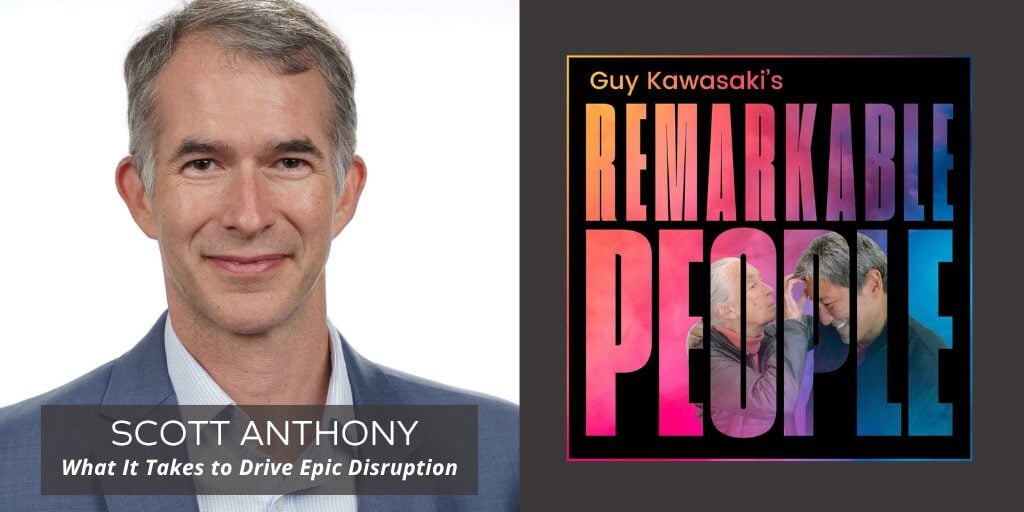
Welcome to Remarkable People. We’re on a mission to make you remarkable. Helping me in this episode is Scott Anthony.
Scott Anthony is one of the world’s leading experts on disruptive change. A professor at Dartmouth’s Tuck School of Business and a longtime partner at Innosight, he has worked alongside Clayton Christensen and advised global companies navigating moments when success becomes a liability.
In this episode, we explore why disruption is often misunderstood and why innovation alone is rarely enough. Scott shares insights from his new book, Epic Disruptions, revealing how history’s most transformative shifts were driven not by lone geniuses, but by teams, timing, and a willingness to rethink what already works.
Our conversation ranges from Procter & Gamble and Apple to Julia Child and the printing press, uncovering patterns that repeat across centuries. Scott argues that the real work of disruption is making things simpler, more affordable, and accessible—long before the data makes change feel safe.
Please enjoy this remarkable episode, What It Takes to Create Epic Disruption with Scott Anthony.
If you enjoyed this episode of the Remarkable People podcast, please leave a rating, write a review, and subscribe. Thank you!
Transcript of Guy Kawasaki’s Remarkable People podcast: What It Takes to Create Epic Disruption with Scott Anthony.
Guy Kawasaki:
Hello everyone. I'm Guy Kawasaki. This is the Remarkable People Podcast and we are scanning and searching the world for remarkable people to inspire and inform you, and we have found another remarkable person.
His name is Scott Anthony. He's a professor at Dartmouth’s Tuck School of Business and basically is a world renowned expert on navigating disruptive change. In fact, he kind of wrote the book on it.
He is a longtime partner at Innosight, and he’s a mentee of Clayton Christensen. And Clayton Christensen is truly one of my heroes. He wrote The Innovator’s Dilemma. Scott has been working with companies like Procter and Gamble and large global giants to help transform their business models. He's a prolific author also, and one second, let me get my book here.
Scott Anthony:
Most important thing of the introduction, Guy.
Guy Kawasaki:
This brief commercial break. This is his latest book. It's called Epic Disruptions, and that's the topic today. Alright.
Scott Anthony:
It's a pleasure to be here.
Guy Kawasaki:
So long time no see.
Scott Anthony:
I think it's been twenty years since we last saw each other just about, but we're not face to face, but we are face to face, such as the world in 2025, 2026, et cetera.
Guy Kawasaki:
I thought you looked familiar.
Scott Anthony:
I had glasses then and the hair might have been a slightly different shade at the time, but such is time.
Guy Kawasaki:
I assure you that my hair was a very different shade. So first of all, I would like to ask you a question. Are there examples of companies that have been disruptive more than once?
Scott Anthony:
Who have been disrupted more than once they felt, or they have done disruption more than once, which one?
Guy Kawasaki:
Have done disruption more than once.
Scott Anthony:
Yeah, for sure. You mentioned Procter and Gamble in the beginning, and I think that is a great example, and through its history, about every twenty years, it comes up a big, new disruptive platform.
So you've got the origins of Tide as the wash day miracle in 1930s and forties, and then Crest in the 1950s, Pampers disposable diapers in the sixties and seventies, et cetera, et cetera.
In each case, following the pattern of disruptive innovation, taking things that once were complicated and expensive and then simple and affordable, driving explosive growth changing market dynamics. So that's a pretty good example of it.
Guy Kawasaki:
Okay, so why has Procter and Gamble been able to do that and Kodak and Data Journal and Smith Corona and Remington Rand and Wang, why are they gone?
Scott Anthony:
There's a two part I would give to that. First, I would say one of the things that Procter and Gamble has been able to successfully do is go and disrupt other categories. So it's gone and disrupted the way that you clean clothes and the way that you put diapers on babies and clean your floors and so on, that is not disruptive necessarily to itself, and the business model it follows.
The companies you all had a dominant business model, a dominant approach that got disrupted, and that's harder. If you're a multi-product, multi-category company and you can go and play offense in different places.
It's easy to say, “I'm going to go and use disruption and go and create the next category, the next part of my business unit, et cetera.” If disruption comes at you and you've got, in essence, one thing, that can be really hard, not impossible, but can be really hard.
Guy Kawasaki:
So is there an example of a company that did that where they were fundamentally in one thing, and they didn't go into diapers or go into different kind of detergent, but they stuck to their knitting and disrupted again.
Scott Anthony:
I think a recent example of this, which is pretty interesting, is Schneider Electric, which is a French industrial company, which is not exactly where you expect to look if you're looking at someone who has successfully responded to disruptive change, but it followed a pattern that I detailed in my 2017 book, going back in a little bit, called Dual Transformation.
Where it's simultaneously embraced digitalization in its existing products and also created new services, value added services that use smart connected devices and so on. So it was able to catch disruptive trend, and both defend what it currently had and went and played offense to go and create what it didn't have. So it's an example of an established company that had a pretty concentrated portfolio that responded to disruption in a very positive way.
Guy Kawasaki:
Well would you say that very few companies are disruptive more than once, so maybe you declare victory, you're disruptive, you're a cash cow and you take the win and you don't make yourself crazy because 99 percent of companies have never even disrupted once.
Scott Anthony:
Well, I'm an optimist by nature. I'm a believer as Clay was. If you understand the forces that work on you, you are able to take something that is an anomalous outcome and make it more normal. So that is the bet though, if you see a large established company and you see disruption taking place in or around it, the safest bet to place that it's going to screw it up. That's what history shows. That's what experience shows.
But increasingly, examples of companies that don't do that. As an example, if we just stopped at The Innovator's Dilemma, then the last two decades of tech would not have happened. So Apple would not have done the iPhone. Microsoft would not gotten the Cloud and artificial intelligence right. Meta would not have gotten social networking on mobile phones and messaging right.
So all the big tech companies that have elongated their lives before The Innovator’s Dilemma would've had one shot. That they would've gone and done their one thing and failed. For better or for worse, large established companies have learned that they can ride additional waves of disruption.
And I say for worse because sometimes it's actually good that you get creative destruction. And you get the old falling in, the new coming in. That leads to a degree of vibrancy versus companies trying to protect. But maybe a whole different line of discussion.
Guy Kawasaki:
I think this is not for just a semantic point of view, but perhaps it would be very helpful for you to the difference between disruption and innovation because somebody might say, “Well, those companies continue to innovate,” but I think you're saying they continue to disrupt, which is in my mind different.
Scott Anthony:
Absolutely different and related course. So innovation broadly is something different that creates value, and that's an intentionally broad definition. It leaves room for lots of categories underneath it, and disruption is one of those categories underneath it. The way I define disruptive innovation is something takes what once was complicated and expensive and makes it simple and affordable, and by doing so, it changes market dynamics and it drives explosive growth.
The key thing in that is the disruptor is playing the game in a fundamentally different way. It's not trying to do what the old guard was doing better. It's tried to do something very different, and if you look in the details of Clay Christensen’s original research, that means often the disruptor isn't starting squarely in the mainstream.
They're starting in the underbelly of the market or a completely different market. It means often the disruptor is making money in very different ways that look foreign to the market leader, and often the market leader is plenty happy to have the disruptor exist in the early days until it gets better and better and ultimately serves as a competitive threat.
So that's the distinction. Innovation, broadly, something different that creates value. A disruptor, in short, does it really differently and therefore changes dynamics.
Guy Kawasaki:
This may be heresy, but as I was reading your book, I kept thinking to myself, maybe Clayton Christensen should have called his book The Disruptor's Dilemma instead of The Innovator's Dilemma.
Scott Anthony:
Say a little bit more, Guy. Why do you think? I love the hearsay. We have two heretical acts already, worldly admitted nine.
Guy Kawasaki:
I am familiar with the book, and I am now familiar with your book, and it seems that the message here is that a disruptor must continue to disrupt otherwise it slides into innovation. Then after innovation, it's just very lucrative, and then pretty soon it becomes irrelevant. So if you want to continue to disrupt, that is a higher bar than the continue to innovate.
You could innovate with an existing product. You cannot disrupt with an existing product.
So I think the higher bar and the more interesting case is The Disruptor’s Dilemma that you disrupted the phone business but now what the next thing you're going to disrupt as opposed to innovate existing phones.
So maybe Clayton Christensen is up there shaking his head at Guy or he's saying, “Guy. Yeah, I never thought of that.” Plus, I like alliterations and The Disruptor’s Dilemma is a better title.
Scott Anthony:
Having worked with Clay for twenty-five years, I, think he would be shaking his head saying, “Gosh, Guy, that's a really good idea, and dang, I wish I would've thought of it.” And I think those are the exact phrases he would've used, you're exactly right.
One of the kind of paradoxes of the world of innovation is you disrupt. You go and create a new paradigm, but then in the language of Clay's original research, you sustain to extend that paradigm and then you're locked within it.
So you mentioned the phone, the Apple iPhone, very disruptive product. It brings computing into people's hands and people's pockets. Probably the most successful product in history. Then people say, “Okay, what's next?”
And it's hard to do the most successful product in history twice, and a lot of credit to what the team has done to sustain success over the past decade. But still at some point, you got to do it again.
Guy Kawasaki:
From the outside looking in, what are the patterns that you recognize for a Procter and Gamble or an Apple or, you can make the case that Google with Gemini has disrupted again, right? So now what are the patterns? What are the best practices that a Fortune 500 CEO could ask you? So, how do I do this, Scott? How do I be like Apple or be like Procter and Gamble?
Scott Anthony:
There's a lot that we could talk about here, but I will highlight two points. One is a friendly amendment to the line that Andy Grove from Intel used to use, Only the Paranoid Survive, his line. So you're always looking for the threats. My friendly amendment to that is only the paranoid survive, but only the optimistic thrive.
I think you see in these companies a belief that which they have is finite. That they always have to be looking out for the things that will get it, but also a belief at the same time that in doing so, they can create new growth, reach customers, reach new market because the problem pure paranoia is it makes you very defensive and it makes you very rigid in how you respond. And you can play defense, but you can't play offense.
So there is this almost optimistic paranoia that they have. That's one. Two, you recognize if you are truly going to do new things, you have to do what Procter and Gamble did all the way back in 1954 when they're trying to go into the disposable diaper category.
They don't say, “Let's ask existing unit that's really busy doing all the things that it's doing to simultaneously go and pioneer. Let's create the organizational space, the exploratory products division that’s going to go and do this.”
So organizations that do this serially recognize we have to make sure there's space for the new stuff. And it sounds simple, but it's actually really hard to do inside established organizations because the drumbeats and rhythms and routines are all choreographed to make today better, not to do tomorrow different. So it really required very active leadership to get it right.
So, there's more, of course, but those two ingredients, the optimistic paranoia and giving space and sometimes, not sometimes, and always time for the new. I think those are two essential ingredients for success.
Guy Kawasaki:
Well, based on my personal experience, I would absolutely say that that's true with the Macintosh division. We were paranoid, but we were optimistic, and it really was a case like that, and we were trying to make something complicated, i.e. personal computer, simple and try to reduce the price.
So, and then of course, if the Board of Directors of Apple in 1980 would say, “You know what? We need to disrupt ourselves. We need to create a new personal computer built on a graphical user interface. W.Y.S.I.W.Y.G., blah, blah, blah, and we are chartering the Apple Two division to do this, to evolve to this next kind of computing.”
Apple would not be around today. It took a separate business unit, the Macintosh division. It took an egomaniac, Steve Jobs, who was co-founder, so he could do anything he wanted. And basically we ran rough shot over the Applet Two division. I'm not advocating that part.
Scott Anthony:
In the end for the good of the organization and the good of the world. And Apple of course replicates story with the iPhone. It'd be very easy. We forget this now, of it'd be very easy for Apple to say, “Hey. We've got this business, the iPod business. It's a super good business. It's what's brought us back from the dead. Why would we do something that might cannibalize with the phone? Let's just go and milk everything we can out of this.”
And the iPod business died and that was good for Apple. So this is something, again, a little bit of willingness to, what do they say in writing? “Kill your darlings.” You have be willing to do that sometimes.
Guy Kawasaki:
Okay, but now for Apple, I don't see the VR thing as that big a deal. I don't see the Watch as a big deal. What's the next thing? What does Apple do to disrupt? It can be more innovative with including AI into its entire product line. Isn't the bar higher for Apple? What's the next disruption? What's going to make me go to an Apple store at midnight so I can get the thing in the morning?
Scott Anthony:
That's a great question. Well, I got my Vision Pro a few weeks ago. My kids finally convinced me, they said, “Hey, this is your field. You just write it off as a business expense.” And I did, and it’s super fun to play around with, but you're right, is still way too expensive and too cumbersome and there's not enough software on it for it really to be something that you say, “This is the next one.”
I think you have for Apple three possibilities, one of which they've already opted out of, which is the car. So, you look and see what's happened in China. It is Huawei and a lot of consumer electronics companies that have done it. Apple tried but gave up so that one's gone.
So you got two chances left. One is something with mixed and augmented reality and hey, just because the first second isn't the breakthrough, the Apple Newton didn't get it quite right. It took time until you get to the iPhone, so I wouldn’t give up on that.
And then the third thing that I have just been watching and waiting for about fifteen years now is healthcare. Healthcare is a multi-trillion dollar industry that needs a lot of disruption. And you look at the functionality that Apple has put in its Watch and in other places, and you can see the beginnings of something that really could be a very sophisticated play at primary care and related areas.
It requires several steps to get there, but that's the sort of thing that you say if any industry in this world needs Apple's ability to simplify and bring elegant design, my goodness, it is healthcare. So that's another one that I have long believed is possible, really hard to do. And the point you've made is true, Apple's reward for having the most successful product in history is everything else is going to look worse by comparison.
I remember a couple decades ago, back before I was a professor and I was a consultant doing consulting work for newspapers, and they said, “What we need is we need a business that's as good as the classified ads were getting disrupted by Craigslist and other things.” Those classified ads, 80 percent gross margin.
I said, “There is no such thing for you. You'll never get a business like that. That was a historical anomaly. Your question isn't, will I get a business as good as this or not? Your question is, will I have a business or not?” By framing the question as a business as good as this or not? Well, we saw how that one played out.
Guy Kawasaki:
Well, honestly, I think the only way you can say that “Oh, we disrupted and had this business just as good as our classified business,” is after the fact. I don't know how you predict that. You take a lot of shots and then you declare victory where victory occurred, right?
Scott Anthony:
There was an article in the MIT Sloan Management Review last year that said exactly that, it said, “When you look at true radical innovation, it is impossible to fully predict it “ex ante.” Now, that doesn't mean that’s not worth investing in. You're creating the surface area for good things to happen.
Even if you fail with something, you learn how it works and you learn the good MNA candidates out there, blah, blah, blah, blah, blah. But saying that, you know for sure this one's going to make it, never possible.
Guy Kawasaki:
Not even with somebody from Tuck School of Business or Harvard Business School?
Scott Anthony:
No. One of the points I make in the book is that innovation disruption in particular is predictably unpredictable. There are patterns in it for sure. So when I see someone who is purposely training off performance in the name of simplicity, when I see they've got a protected starting point away from the mainstream.
When I see they've got a powerful business model that's money in different ways to say, “This could be one of those,” but could be because stuff we're doing work in complicated systems that are run by complicated individuals, so weird things happen.
You can't fully predict that in Tesla's early days it's going to get 800 million dollars in government loans and that's going to change the way things play out, whatever weird things happen. So you use the patterns to increase the odds, but you recognize that stuff happens.
Guy Kawasaki:
Since you brought up Tesla, who would you say is the bigger disruptor? Elon Musk or Steve Jobs?
Scott Anthony:
Oh God, that's a great question. So if you look at the dictionary definition of disruption, I don't think there's any doubt about that. If you look at the way that we're talking about disruption in the Clayton Christensen sense.
I think the history's still being written, but I think you got to give the edge to Elon Musk because you have the collection of not just doing it at Tesla, but SpaceX, The Boring Company, all the things that he has done, and some of them haven't worked and some of them have had some downsides to them.
But it's a really interesting, in fact, totally unique portfolio of efforts driven by a singular vision to go and back up society on Mars. It unlike anything we've ever seen before. And Elon Musk, of course, is a complicated and very polarizing character. I tell my kids, maybe don't replicate the person, but the business stuff, that's good. Could you get one without the other? I don't know. That's a great question.
Guy Kawasaki:
I hesitate to say this, but I have to admit that I agree with you, and I don't know Elon Musk personally. I knew Steve Job. Steve definitely disrupted computers and phones and digital devices. But Elon is like satellites and tunneling and cars and solar panels you name it, right? Chips in your head. It's a scary thought there.
Scott Anthony:
At the graduation ceremony for the class of 2025 from our business school, our Dean, Matt Slaughter, who is a consummate optimist which I love because I am too, told the graduates, “The world stands at a crossroads,” no one disagrees with that, he said, “of extraordinary possibility.” And I love the way he framed it because that is a way to look at the world right now. Others would've chosen other words to end that sentence, but I like that frame of the world.
Guy Kawasaki:
And wait. Are you making the point that things are so screwed up that it is a time of great opportunity?
Scott Anthony:
This is absolutely. The way that I frame it is in the 1940s, Kurt Lewin, who's of the fathers of thinking about organizational design and behavior, put forward this very simple model.
He said, “At any given moment, an organization is frozen. You cannot change it. Something leads to it unfreezing. It might be a charismatic leader or shock, whatever. Then you can change, but you have to move quickly because it refreezes and then change again is impossible for better or worse.”
I think you can call the time we're in right now “The Great Unfreezing,” which is very disconcerting and can be very hard to get through, but it also creates once in a lifetime possibilities.
One specific example, I started teaching three and a half years ago, 2022. I thought it was my reward for twenty plus years of consulting. Schools don't change very fast. Then four months later, ChatGPT comes out. Two years later, Trump is reelected with very clear viewpoints about how to change universities.
So we're on the front line of disruptive change. Is that good or bad? I don't know. If you're Sian Beilock, our president, you have a chance to remake an institution and do things that five years ago would've been impossible, and now they're not only possible, they might even be desirable. So again, that can be a downside, but I see upside in that as well.
Guy Kawasaki:
Now, what are the people who were the CEOs of Kodak or Rand or Smith Corona or Wang, or any of these companies that failed? What were they telling themselves? Were they ignorant of the change or were they in denial?
When Steve Sasson showed up at the Kodak manager's meeting with his new digital camera, what did they say? Were they just in denial? Were they ignorant? What goes through your head that would, especially now with books like yours and Clayton Christensen at this point 2025, you cannot say that “Oh, this is news to me.” What are these people saying to themselves when they deny this?
Scott Anthony:
I remember Guy, it was two thousand, it was right before presidential election. It was 2008. I was on a panel discussion, and it was me, A.G. Lafley from Procter and Gamble, Stephanie Burns from Dow Corning, and I cannot remember his name, but it was the president of Eastman Kodak.
And we're talking about this kind of stuff and what the president of Eastman Kodak said is, “Look, the basic problem we faced is our core business just would not stop growing. So everybody is telling us the future is digital, and we kind of conceptually believed it, but film just kept going up and up and up and up.”
I play a video when I'm with groups. It's with Jim Balsillie, who is the co-CEO of Research in Motion. It's from April 2008, so it's a few months after the iPhone comes out. He's smug.
He's dismissive. He’s talking about how, “Yes, our product portfolio is poorly diversified, but it's going to the moon pretty well. Maybe it'll crash earth, but whatever. It's going well so far, and everyone lasted that.”
I said, “In April 2008, that was truth.” Their revenues had tripled. Their stock price was up 70 percent. Here's the basic problem, the data lags. Everyone suffers from what I call the information action paradox. By the time the data are clear telling you exactly what to do, it's too late to do it. So, what Clay Christensen would say is, “This is where you use good theory or model so you can make sense of the early signs of change.”
The problem if you're a human is all the signals are telling you keep doing what you're doing until it's too late to do anything about it. You do have wise leaders who are beginning to get this, but that to me is the essence of the challenge. Those leaders would all tell you everything looked good. It's the Ernest Hemingway’s The Sun Also Rises line. How you go bankrupt first? Slowly then suddenly. So do you get disrupted? First slowly then suddenly.
Guy Kawasaki:
So one of the things that I kept noticing in your eleven stories in the book is that there seems to be this myth about there's this eureka moment. There's this “aha” moment where a lone genius or two guys in a garage, or two gals in a garage, they have this bada bing, bada bang moment, and in all your examples, it goes back decades and decades. It's not like Gutenberg one day said, “Aha, printing press.”
He was in a place that there were metal workers and stampers and look, a lot of things have to line up. Is it a complete myth that it's a lone genius and there's this eureka moment?
Scott Anthony:
Yes it is. And it's a myth that I used to tell. I used to say, essentially we've been through various eras of innovation, “If you work backwards, there's the venture capital backed startup. There's the large corporate lab, and then there's the loan genius.” And I would say, “Gutenberg is an example of that.”
Until I actually researched it and realized exactly what you said, it isn't a loan genius, it's a team. It's Conrad Saspatch, who is the person who actually brings the team the press. It's Nicholas of Cusa, who is the early customer. It’s Johann Fust, who is the investor, who side note, ends up suing Gutenberg and takes over the technology, which is another thing I didn't know.
So, there of course are people who are playing outsize roles and there's no Apple iPhone without Jobs and singular things he did. There's also no Apple iPhone without, you know this better than anyone, without people like you doing work that you did on the Macintosh. You can't just have a leader who wills things into being. People have to do stuff.
It's one of silliest things I realized in the book. I've written other books before, and in those books when I would write a sentence about innovation, the subject in the sentence would be a company. So Apple did this, Procter and Gamble did this. No company does anything.
It's people who do things and often, not often, always collection of people do things. It is an individually collective activity.
Guy Kawasaki:
Well, okay, so let's take that as a given. So now knowing that, what's the best practice? Knowing that, what do I do?
Scott Anthony:
So a couple things. Number one, if you're an individual, find a squad to go and hunt with. So find people who can complement you, who can give you different capabilities, blah, blah, blah, blah, blah. Just like Julia Child, one of my favorite stories in the book. She doesn't go and do all of her stuff on her own.
Her first book has Simone Beck and Louisette Bertholle as co-authors. Paul Child’s helping in the background with experiments. She's got Avis DeVoto who helps to make connections.
Judy Jones, who's her publisher. Find your squad. If you're an individual. If you're inside a company, you're a leader and you want to boost ability to innovate, create a culture where the behaviors that drive innovation success are celebrated, rewarded, in fact habitual.
So make it easy for people to go and understand customers run experiments and be curious and all the stuff that is part of the human condition, but we grind out of people inside organizations. If you want more innovation, it isn't just trying to find Steve Jobs reincarnated and bringing him to your organization. It's creating the conditions where he and people around him can go and flourish.
Guy Kawasaki:
So do you think that one of the telltale signs that a company is really in trouble is when it has a chief innovation officer?
Scott Anthony:
I don't think it necessarily means they're in trouble or a chief AI officer today would be the kind of new equivalent because I do think the role, if it is done well, can be a value added role and can help with a bunch of things if the chief innovation officer is reporting to chief marketing officer, and all the funding comes from the marketing budget then I get really worried.
If the chief innovation officer is reporting the CEO or the CFO or a place where real resource allocation decisions are made. Different thing. It is a little thing I would do whenever I would go into a company and they would show me innovation lab, which always looks cool, right?
No one ever shows you a dud innovation lab. You just ask who's paying for it. And if it comes from marketing and PR, well, you got your answer. They're not serious about it. So I don't think it has to be, it just depends on how things are set up.
Guy Kawasaki:
That's a good test. I don't think you mentioned it, but did you know that Julia Child was a spook until she moved to France? Isn't that a great story?
Scott Anthony:
I mean the whole Julia Child story is just a fascinating story. The path to get to where she got to, like all innovators, is a winding path and it's a reminder that people are not born. You don't come out as a fully-fledged innovator. Julia Child was not born a great cook. She's born in 1912. She moves to France 1948. Falls in love with French cooking. 1951, she fails the exam at Le Cordon Bleu, and she said, “Well, it was rigged against me, whatever.”
Whatever, she still failed the exam at Le Cordon Bleu. The first meal she ever cooked for her husband, Paul Child, was wait for it, brains simmered in red wine sauce. She had the detour through being a spook. She also was a magazine writer at one point and the first forty years of her life, she's not someone who you say, “This person is poised for greatness.” Sometimes we bloom late.
Guy Kawasaki:
The reason why I even knew that story about Julia Child.
Scott Anthony:
Is you’re a spook too? Is that why?
Guy Kawasaki:
No. It's because of ChatGPT. So I was writing with Madisun a book called Think Remarkable, and I wanted to talk about the concept people start in one industry and make a completely different change. To go from spook to cook, for example. And so I went to ChatGPT and I said, “Give me examples of people who were very successful after a dramatic career change.”
And of course it tells me Jeff Bezos, who was a private equity kind of guy, switched to e-commerce. But then it said, “Yeah, Julia Child worked for the OSS until she moved to France with her OSS husband, and she fell in love with French food and that's how Julia Child became Julia Child.” So without ChatGPT, I would've never learned that story.
Scott Anthony:
There you go. The parallel example to that is of these things that was just staring at me in the face, and I didn't realize until someone, my publicist for the book said, “We want to do an article something for AARP. Do you have any examples in the book people who are older than fifty?” I'm like, “I think so,” but I hadn't looked at it. So I first went to Julia Child of course and she did turn fifty the year her cooking show came out. So check.
But then a chapter right before that is about McDonald's and the McDonald's stories. The brothers had a hamburger stand and then this milkshake equipment salesperson, Ray Kroc shows up in 1954 and he says, “My God, you are sitting on a gold mine. I'm going to leave that and going to become the master franchiser of McDonald's.”
He was fifty-two and the argument that I now make, and this is totally self-serving. I turned fifty this year. Disruption begins at fifty because you have the crystallized wisdom that allows you to see things that other people are missing. And we know that fluid intelligence rises rapidly and peaks at twenty or thirty or thereabouts begins to decline.
So your ability to do super-fast processing does go down over time, but crystallized intelligence continues to go up and because so much of disruption rethinking and refashioning systems, I think there's something to be said that wisdom and age are benefits, not curses which goes totally against what most think, which is, it's the nineteen year olds or whatever that are all the people who are entrepreneurs. Yes, of course there are examples like that, but there's room for us older folk as well.
Guy Kawasaki:
Well, I am seventy-one and so I think my crystals are all turning to sun and dust right now, but that's okay.
Scott Anthony:
I just was looking at the research around this. Teaching is one of the few fields, and again, this is totally self-serving, where performance improves over time. Most fields, at certain points, performance begins to degrade. But even in sixties and seventies, you look at teacher ratings for, not everyone, but for many teachers, they continue to go up because they have more wisdom to draw on to be able teach their classes.
So Guy, you want another career? There's space at the Tuck School of Business. You want to come and experience Hanover, New Hampshire winter. It's just waiting for you.
Guy Kawasaki:
Well, it's always good to have backup plans, but I would make the case that podcasting is like teaching that the older you are, the better podcaster you are because I have much more data to interview someone like you about innovation and disruption because I'm seventy-one and I've been through it as opposed to what somebody who just graduated from Northwestern in journalism.
What's that person going to ask you about with Clayton Christensen?
Scott Anthony:
Absolutely. And they could ask the same question but then the follow up, the depth, the nuance, that is all lost. It's interesting. I teach a class about gen AI and consultative decision making gen AI and consulting. Half of our graduates go into consulting, so natural thing to do.
And the number one thing that I teach them is you got to do the work to develop the wisdom. And if you offload, you will never develop the wisdom and that will make you a bad advisor. I have them read the short little interview that Jerry Seinfeld did with Harvard Business Review in 2018. It's an awesome interview.
The person saying, “You had this great show, but you burned a lot of people out for micromanaging, et cetera.” The interviewer said, “Wouldn't it have been better if you'd hired McKinsey?” And Seinfeld said, “Who's McKinsey?”
Guy Kawasaki:
No.
Scott Anthony:
And the interviewer says, “They’re a consulting company.” And Seinfeld says, “Are they funny?” And I cut my teeth at McKinsey, so I will attest to this the interviewer said, “No, they're not funny,” and Seinfeld said, “Then they would not have helped,” and this is the thing he said, “The right way is the hard way. It was because I micromanaged the show that it was a great show. The right way is the hard way.”
Of course, there are easy things to do if you want quick answers and shortcuts, but the right way is the hard way. You want to be wise, you have do hard things. You have to get the experience that will make you better over time.
Guy Kawasaki:
I got to ask you Scott, who the hell asked him that?
Scott Anthony:
I can't remember who the interviewer was. It is easily discoverable on Google, but it was a Harvard Business Review interviewer. It was the back page of 2017 or 18, one of issues. It's interestingly, it works better with certain audiences. My MBAs really like that. When I shared it with undergraduates, enough of them are like, “Who's Seinfeld?” That they didn't quite get it, which made me a bit sad, but so there you go.
Guy Kawasaki:
I hope the interviewer's last name was not Welch.
Scott Anthony:
Yeah. No, it was not Suzy. That’s a whole different conversation. That was before or after.
Guy Kawasaki:
In your Gutenberg example, I found one thing very interesting is that the church was kind of his first customer, right? And on the other hand, you also point out the democratization of the replication of Bibles, the spread of religious information was also threatening to some people because they lost a monopoly on the Bible, right? What's casts a shadow over disruption like that?
Scott Anthony:
This is in the category “be careful what you wish for.” So you know the Catholic Church, you can understand why they love printing press at first because they want to standardize religious services. It takes three years to inscribe a Bible. Now you can do it like that. The problem is that Martin Luther can also like that go and publish information about different views of religion.
The printing press led to the splintering of the church, the reformation and the creation and the promulgation of lots of different religions. So in modern times, the “be careful what you wish for,” I think is consulting companies in artificial intelligence. Right now, consulting companies like McKinsey and Accenture and BCG and so on are making a ton of money helping their clients implement artificial intelligence.
What happens when those clients say, “Hey, great. We can now do all that we used to hire you to do because we have this great new capacity inside our organization.” The second order effect can often get you. There's always a downside. There's always a shadow to disruption.
Guy Kawasaki:
I find it inconceivable to retain a firm like McKinsey to help you disrupt. Am I being too harsh? Am I being too negative? Like, what a Harvard Business School, MBA, what is that person going to tell me about how to disrupt the steel mail business or something?
Scott Anthony:
Having spent twenty years of my life as a trying to advise people to exactly that in a smaller, much smaller organization than McKinsey. I'll say that if you do it well.
What you're helping people to do, I remember one of our said, “You were a helicopter, a mirror and an architect. Helicopter, you helped us get a level higher. Mirror, help us understand the things that we didn't see in ourselves that were holding us back, and then architect the things that we were going to do.”
So, again, there is a pattern to disruptive innovation. So that's something that good advisors can help you with. I understand your skepticism because you also need people who are just a little bit, you know, your old advertising campaign. Here's to the crazy ones, just a little bit crazy, and that doesn't come from a structured analytical approach that a management company will typically do.
So in my mind, when we got it right in a site, it'd be a mix of yes, we're going to take a scientific approach and we're going to walk away from it, and we're going to allow a little bit of craziness and allow a little bit of mess, which was easier, arguably for us as a small organization to do than a great big behemoth like McKinsey. But it's my two cents on the topic.
Guy Kawasaki:
Okay, so if I am an entrepreneur listening to this and I'm not yet fifty and I'm thinking, So, here I am. I've been asking myself how do I disrupt an industry? Maybe the better question I should be asking myself is, how do I make things cheaper and simpler?
Which is a very different question. Like, so do successful disruptors, are they sitting there wondering how to disrupt or are they just sitting there thinking, how do I make this cheaper and simpler?
Scott Anthony:
I think the good ones are doing the latter. I don't think they’re saying, “How do I disrupt?” They're saying, “How do I solve a problem that's not well solved? How do I go and allow a broader population to be able to enjoy things? How do I radically change cost? Blah, blah, blah, blah, blah.” I think if you start with premise, how do I disrupt? I don't know, it just leads you to a different place.
You're trying to get an outcome as opposed to really achieving something with a consumer or customer mindset. So I think starting with the premise, like Henry Ford. Henry Ford, this was before anyone had any around this, but Henry Ford, his vision was a car for the great multitudes, which means he was obsessed with making things as cheap as possible.
So, people say, “He was a bad marketer.” You can have any color you want, long as it's black. But that was because he wanted to get down and at that point that was everything and did it. Prices were 30,000 dollars in today's terms when the Model T came out, down to 5,000 dollars in today's terms by the early 1920s. And that's why the automotive age happened because he took something that was complicated and expensive and made it affordable.
There was a great book that came out, in 2025 first half, about Taylor Swift and the lessons you can learn from Kevin Evers, who was actually the editor for Epic Disruptions. And one of the things he talked about was exactly this, Taylor Swift has been incredibly innovative, but she said, “At no point do I wake up saying, ‘let me innovative.’” Instead, she says, “How do I connect more deeply with my fans? How do I find new ways to spread my music in different places?”
Innovation is a means. Disruption is an approach. The end goal is that connection to fans and that ability to serve customers in different ways and so on.
Guy Kawasaki:
Which is to say that in summary, that disruption is a means to an end. It is not the end in itself.
Scott Anthony:
I tell you, Guy, one of the never ending debates I would have back in my client service days is people would say, “Is this or is it not disruptive?” And I would usually end the debates by saying, “I don't care. That's not really the important question. It fits an academic definition of the question is, is there a customer problem that you are solving a unique way that enables you to make money? That's all that matters.”
And disruption is a lens that can lead you to look in different places. It's a tool that can help you then go and fine tune, but it's not the end. The end is ultimately something that delights a customer leads to them spending money, time, and telling other people about it.
Guy Kawasaki:
I'm telling you that lots of heads are going to explode if they hear us say this. I don't see many people sitting around thinking like, How do I make things cheaper, simpler? They're always trying to get like funding for disruption and, or maybe it's because of where I live, but yeah.
It's a very different perspective out here. So listen, one of the great examples in your book was about controlling the narrative, and God, I should have wrote it down, but I forget the term. You talk about when the cars of Henry Ford example that. What part of the narrative was the “jaywalker,” and the other part of the narrative was this word that I cannot remember right now with two v’s?
Scott Anthony:
It’s a beautiful word. A “flivverboob” was the other word. “Flivverboob.” F-L-I-V-V-E-R-B-O-O-B, two v’s.
Guy Kawasaki:
Okay. So now explain controlling the narrative with the “jaywalker” versus the “flivverboob.”
Scott Anthony:
So yeah, this is something that has a lot of pertinence today. So, back to the Model T story, Henry Ford achieves his vision, has the car for the multitude sales explode. A problem erupts. Cities are built not for cars, but for people and horses. So you've got this great battle. You've got chaos in streets, sadly. You have carnage as well. How do you get through it?
Well, technologies like traffic lights, norms. Who gets to cross the street where? Well, there were two sides. There were the motorists who said, “We want to own the road, so let's brand the people who are wandering in the road something bad. We'll call them ‘jaywalkers.’ Jay was a country bumpkin, so we'll get the Boy Scouts to hand out cards saying, ‘You don't want to do this. You don't want to be a ‘jaywalker.’’”
The pedestrian said, “No, it's not our fault. The motorists are driving like maniacs. Let's brand them as ‘flivverboobs.’” Flivver is old time slang for a car boob. Well, that's pretty universal. You know who won this? You remember the word nobody does. The word stopped being used 1929. Ultimately it was the motorists who got the right of way.
So you get the technology, you get norms, and then you get regulations, things like you need a driver's license to drive a car, or if you go above a posted speed limit, we are going to fine you or later you have to wear a seatbelt and so on.
The reason why I think this is important is we are dealing with some big technological developments right now where there's plenty of technology being developed. There's norms and there's battles between for AI boomers and doomers and so on, and we're working through that. But the general view has been, “Hey. Let's just keep our hands off it. Let's let technology develop and then it will all work out fine.” History suggests that might not be the best answer.
Guy Kawasaki:
So what is your suggestion there then?
Scott Anthony:
So I am not an expert, so let me be very clear, but none cannot possibly be the right answer. So at the very least, as a parent of four children, I look at what they are able to do with their phones on social media. And I say, “This just can't be good for people.” And then you add on top companions and so on from AI, and it just makes you shiver in fear.
My nine-year-old, he has to face the onslaught of thousands, tens of thousands, hundreds of thousands of people who are fighting for his soul, and that is not a good thing. So that would be one area where the ability to go and reach children, it feels like the sort of thing the government exists to put some guardrails against.
Bob Johansson, who you probably know, great futurist from the Institute for the Future for decades. His view is for artificial intelligence. We shouldn't have boundaries and guardrails. We should have bounce ropes like in a wrestling ring, so there's some flexibility in them, and you could even use them in some ways.
But there's a really fixed stanchions, which they came off of, exactly what those look like.
I don't know, but I know something is better than nothing. Nothing, I think is extremely extraordinarily dangerous. One person's view. I'm not an expert, but that's my view.
Guy Kawasaki:
And now to use the example of “jaywalker” versus “flivverboob” or whatever that word is. How do you apply that to crypto? Crypto, you can make the case you're a crypto bro, and you believe in it, or you're this dinosaur who doesn't get it. Whose narrative are we looking at?
Scott Anthony:
I think you've nailed it. So question will be in the middle, it always looks messy and you look back in hindsight, and you say, “Well, obviously the cars won.” That was not clear in 1924, who was going to win that battle? There were two sides to it. So in of these big disruptive shifts, crypto, alternative meets, new forms of clean tech and so on, you're going to have two sides.
And who ultimately wins? Not perfectly predictable. My own point of view on crypto, if you pull one level up to look at the underlying ledger technologies, I think truly transformational technologies for a whole bunch of things. Asset ownership contracts and so on.
I think we're in that period where there's a lot of noise and speculation and so on, but we will look back and say, “This was the beginning of something really important.” Technologies have to develop. You have new things that need to develop as well, but I think that is a fundamentally disruptive technology for many, many things.
Guy Kawasaki:
Wait, when you say it is a fundamentally disruptive thing, you're referring to blockchain.
Scott Anthony:
Yeah, correct. Distributed ledger technology. Not a specific meme coin or whatever, but no, the underlying technological infrastructure on which things run. Yes.
Guy Kawasaki:
I would agree with that. I am not a crypto believer at all, but I think blockchain is a very disruptive technology. Wow. Okay. I have exhausted all my questions here. I got them covered all here that I wanted to ask you. I share your admiration of Clayton Christensen.
I came to know him a little bit. I have attended his speeches. I have to tell you that I once went to a Clayton Christensen speech, and besides the fact that I was blown away by the message and all that, I got to tell you he had the worst fricking slides in the world. I don't know who made his slides.
Scott Anthony:
He did. Having worked with him for twenty years, I can attest we tried, Guy, again and again to beautify them. You really make me smile sharing. I remember you took me right back twenty, twenty-five years ago when I was a second year student at the Harvard Business School, and I took his class and I'm like, “This is the technology expert. It's going to be all whizzbang stuff.”
And he came in the first class in October, September 2000. He got out an acetate, like an actual slide put it on a projector. He understood how technology changed. He was not a technology user per se himself.
Guy Kawasaki:
I actually offered once to fix all his slides and he never responded.
Scott Anthony:
There's just something about the character. That's just kind of who he was. And I think he liked the ability to just have control because ultimately it was the message that he wanted people to pay attention to, not the materials. And he was the best in the world, so I've not seen anyone better as a business storyteller.
The ability to communicate complex concepts through essentially parables that people would leave, say, I get steel mini mills and milkshakes, and so on, and they can repeat the stories and all that. He was a truly gifted storyteller and a truly wonderful human being.
Guy Kawasaki:
Well, I hope now that Clayton Christensen and Jane Goodall are hanging out together because two very remarkable people in my life, so, yeah.
Scott Anthony:
That's a great thought. Well, Guy, thank you very much for the conversation. I greatly enjoyed this.
Guy Kawasaki:
Thank you. Yeah. So, It's been wonderful. I really like the book. I really like your body of work and all this knowledge, and I hope all you young entrepreneurs out there listening, you're asking yourself, “How do I make simpler and cheaper? Not how do I disrupt things?”
All right, so just let me thank, you know Madisun, the co-producer, Jeff Sieh, co-producer.
I recently saw a podcast where at this point they put up a different graphic and they list the name, says, “Madisun Nuismer, co-producer, Jeff Sieh, co-producer, Shannon Hernandez, sound design engineer, Tessa Nuismer.” So maybe we'll step up our game and innovate. Put that slide up.
But that's the Remarkable People team. And again, thank you very much. Have a great holiday seasons. I hope that you continue to just do this great work and continue to write these great books, Scott.
Scott Anthony:
Thank very much, Guy. Same to you and yours.
Sign up to receive email updates
Enter your name and email address below and I'll send you periodic updates about the podcast.

Leave a Reply