
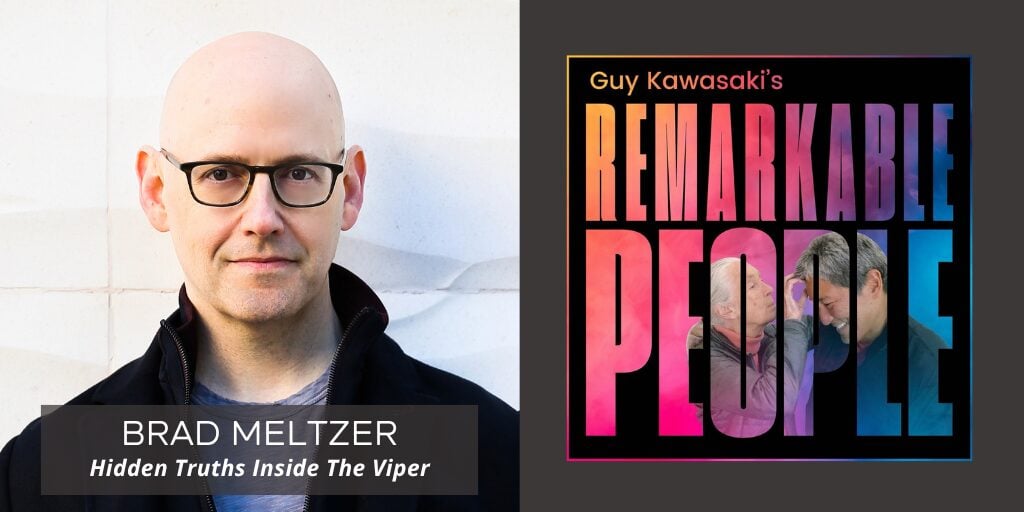
Welcome to Remarkable People. We’re on a mission to make you remarkable. Helping me in this episode is Brad Meltzer.
Brad is a force in modern storytelling. His books have topped bestseller lists for decades, with more than 25 million copies in print. From political thrillers to children’s biographies to television documentaries, Brad moves across genres with uncommon ease—and uncommon depth.
In this episode, we explore the emotional and moral backbone of his latest novel, The Viper. The story begins inside Dover, the military mortuary that receives America’s fallen heroes, and unfolds into a high-stakes thriller involving hidden secrets stitched into a burial suit. But beneath the suspense lies something more personal: Brad’s reflection on grief, closure, and the concept of pentimento—the idea that a painting’s original sketch can reappear over time. He argues that our flaws and regrets are not evidence of failure; they are the underpinnings of our masterpiece.
We also discuss the Witness Protection Program and why reinvention fascinates him. What would it actually take to disappear today? Why do people sabotage their second chances? And what does it reveal about human nature that we long to start over—but rarely can leave the past behind? Brad brings both research and empathy to these questions, grounding fiction in truth.
Throughout the conversation, one theme keeps surfacing: humility. Whether he’s talking about morticians who serve grieving families or parents trying to raise resilient kids, Brad believes real heroism happens quietly. If The Viper proves anything, it’s that suspense may hook us—but meaning is what stays.
Please enjoy this remarkable episode, Brad Meltzer on The Viper, Witness Protection, and Starting Over.
If you enjoyed this episode of the Remarkable People podcast, please leave a rating, write a review, and subscribe. Thank you!
Transcript of Guy Kawasaki’s Remarkable People podcast: Brad Meltzer on The Viper, Witness Protection, and Starting Over.
Guy Kawasaki:
Hello everybody. It's Guy Kawasaki and this is the Remarkable People Podcast. Today we have an author as our guest, and I have read his books before.
As soon as we got the pitch for our guest, Brad Meltzer, I sent an email to Madisun and I said, “Madisun, we must have arrived because now even thriller authors want to be on our podcast, not just the usual social psychologist, and people like that. We're in the mainstream baby.” So, the guest is Brad Meltzer. And he has written number one New York Times bestselling books.
He has more than twenty-five million books in print, which is roughly twenty-four and a half million more books than I do. He's known for thrillers and conspiracies and moral questions, but he also wears many hats, including nonfiction, children's books, video series, like he is just Mr. Everything.
His latest book is called The Viper, and it is in the series of Zig and Nola, where the action hero, believe it or not, is a mortician. He also has this wonderful nonprofit called Ordinary People Change the World. So, he's an all-around remarkable person. So welcome to the show, Brad Meltzer.
Brad Meltzer:
Thank you Guy. So good to be here.
Guy Kawasaki:
Well, this is easier than going on a twelve-city tour.
Brad Meltzer:
No. Are you kidding? Talking from home to someone I respect, that's a far more fun day for me. I get to be remarkable for a day.
When I get booked on something called Remarkable People, I'm like, “Oh, obviously, I'm remarkable now.”
Guy Kawasaki:
We were waiting for you to exceed twenty million copies in print. And, once you hit that threshold, you probably qualify.
Brad Meltzer:
The funny thing was my parents passed away. I cleaned out their closet and as that sad moment, you got to go through your dead parents' objects. And I go through, I see my mom's old eighties outfits with the shoulder pads in them. I see my dad's old ridiculous jerseys, like a grown man that wears a football jersey, and I find hundreds of my books.
I realized my parents have been the ones buying all my books all these years. They just had stacks, and it just gave me such a good laugh in the midst of this moment of such seriousness.
Guy Kawasaki:
Well, you could probably sell them for a lot of money. They’re first editions, right?
Brad Meltzer:
They are first editions all of them. Well, my dad, he used to go into the Barnes and Noble. He'd be like, “Yes, I'm here for Brad Meltzer's new book. He's my favorite author,” and they're like, “Mr. Meltzer, we know he is your son. We know, we got it.” They knew.
Guy Kawasaki:
Oh my God. So, I like to jump around in my interviews, so I want to first be a little bit of a fan boy here, I love The Escape Artist. I love The Fifth Assassin. And with The Viper, I have to tell you, I learned a new word that I never heard before and I love the concept. Can you guess what the word is?
Brad Meltzer:
No, let me just try and guess right. I don't know what it is. I was actually thinking, what's the word?
Guy Kawasaki:
Pentimento.
Brad Meltzer:
Oh, pentimento. The most important word in the whole book. I can't believe you picked that up. That is what the entire book is about, is that moment at the end. Let's talk about it.
Guy Kawasaki:
Well, you see, that's why I'm better than most of the people you're going to be interviewing with.
Brad Meltzer:
I can't believe you picked that up. If you put a gun to my head, woke me up at three in the morning, said, “What's the whole book about? What's your journey personally been these past few years?”
It's pentimento, so pentimento was this phrase I found I did not know it. And it's a phrase in painting that when the paint in an old painting dries up and gets old and brittle it actually, it starts to become see-through.
And pentimento means you can start seeing through the paint and you can see the pencil work underneath. So, you can see the actual first draft that the painter puts on the canvas. And in all first drafts, they get changed. So, you can see that a tree that sways this way.
The artist was like, “No, I'm going to make it go this way.” Or change the composition of a woman's form and her dress is flowing to the right instead of flows to the left. It's the first draft of what they're working on.
And as it says in the book is, “Sometimes we look at our first drafts and we see them as they're mistakes and they're filled with flaws and they're filled with horribleness, and they're filled with errors and regrets. And they are, but you can't make a masterpiece without them.”
I was like, “That's it. That's all I'm searching.” Like I spent so long for myself just taking all those things I regretted about myself and hating about myself and realizing those are the rough drafts and that is how we build our masterpieces.
Guy Kawasaki:
That's right. There's a sentence in that last section about pentimento. I'm going to read it now because when I saw that Madisun and I just finished the book and I really thought, Maybe I should call the proofreader and tell her that I want to switch one of the epigraphs, because this one sentence is so brilliant and this is the sentence, in case you're in suspense.
I quote Brad Meltzer, “In life as in art, the rough draft is littered with regrets and flaws, but you can't make a masterpiece without them.” When I read that sentence, I said, “Oh my God, I got to put that on a poster. I got to put that on a t-shirt, sell it on Amazon.” That is a great line from the book.
Brad Meltzer:
Well, I thank you. You know that line was the longest, hardest line to crack in the whole book, and I knew the sentiment. I knew what I was trying to get at, but I couldn't get around to it. And I said, “I know it's in here.” And I couldn't figure it out. And I went for a walk with my daughter.
I'm talking to my daughter about it and I said, “I feel like those things in your life, the regrets.” And it just blurted out exactly as you see it. As I explained it to her, what I was looking at in life, and I stopped in the middle of the walk and I wrote down exactly what you just read.
And it came from me expressing what I was feeling to my daughter. And then I realized this is the answer to the whole book.
Guy Kawasaki:
Really?
Brad Meltzer:
And it came from me expressing what I was feeling to my daughter. And then I realized this is the answer to the whole book. Truly my favorite line of the whole book.
Guy Kawasaki:
Okay so, in February or March when you're done with your media tour, I'm going to reach out to you and I'm going to say, “Brad, tell me the truth. Did any other person on your media tour bring that up?”
Brad Meltzer:
I want to test it. I want to see. I'll wager good money that no one's going to, because people, they'll pick different things. They like different things.
I wish you could see inside my body right now to realize, to fully prepare that I'm in a little bit of shock that of 400 pages in a book, you picked out my favorite sentence on the first boom, on the first interview question. It's craziness. We can only go downhill from here, Guy.
Guy Kawasaki:
Maybe we should end this interview right now.
Brad Meltzer:
I was going to say. I can't wait to see what you're going to ask next with a big one like that.
Guy Kawasaki:
Okay. Here's my next question. My next question, is Pat Tillman's jersey really in the Dover Mortuary or whatever you call that hospital?
Brad Meltzer:
Dover. It is. Everything in the book, all those things are real. I don't make them up. I love research so, I got involved. I've been doing, for years, work with the USO and during wartime, as the war was winding down in Afghanistan and Iraq, they were bringing thriller writers, six thriller writers every year to go entertain the troops.
And toward the end, as the war was winding down, I got to go there, and that's where I first heard of this place called Dover. I didn't know what it was, and they explained to me, we all know Dover, even if we don't know the name of it, it's where those flag covered coffins, like Pat Tillman's, when it comes off the plane and everyone salutes.
That's Dover in Dover, Delaware. And it's a funeral home that houses all of our fallen soldiers, service members, men and women who give their lives fighting for the country. But it's also where when the space shuttle went down, all the astronauts’ bodies went to Dover. When September Eleventh happened, all the Pentagon victims went there.
And all of our spies across the globe, our double-oh-sevens, wherever they are, their bodies go to Dover too, which means that Dover is a place that's filled with secrets. America's most secretive funeral home. And I was like, “I want to go there.” And I went there and I met the morticians who work there.
And the morticians will spend twelve hours rewiring someone's jaw, smoothing it over with clay so a family can see their child one last time. Rebuilding someone's hand because the mother says, “I want to hold my son's hand one last time before you bury them.”
And I was blown away by the commitment that they put into this. And one of the mortician who I met is a real man named Zig, who I based the name on. There is a real Zig and he was the one who worked on Pat Tillman's body. And Pat Tillman's jersey is really up in Dover. And so that opening scene when you see it walk past, I didn't make that up.
That's actually really there to this day. They are the ones who got Pat Tillman's body when it came back obviously.
Guy Kawasaki:
So, I don't want to get too depressing. This is a serious question. So, you know somebody's body like that comes in, you're the mortician, you pull out the bullets and you say, “These bullets are from an American gun. He was killed by friendly fire.” Is that the kind of thing that could happen there?
Brad Meltzer:
Anyone who goes down, friendly fire, an IED, a suicide, you crash your motorcycle because you're trying to be Tom Cruise. That's what goes through there. And of course, like you said, it sounds like this depressing place. What struck me is how much this place is committed to life.
There's a line at the beginning of the book on page one of the book and it says, “I don't believe in closure. I don't think we ever really get over anything.” And that's what the book is dealing with is all these people, what we're all struggling with when it comes to death.
And for this book, for The Viper, it was me dealing with the death of my parents still trying to find closure in a place I couldn't find it.
And I know that sounds serious and that sounds whatever, but the people there have the best sense of humor, the most amazing outcomes of life. And I'm like surrounded by so much death. These are the most inspiring people I can find because they are trying to give closure to all these families that have no business ever thinking they're going to get it.
And somehow, they keep trying to help these families along doing incredible things that no one knows, that they never take credit for. Remember when humility was a great American value? Seems like it's gone these days, but not in Dover.
In Dover, there's a place still of hope where they're saying, “We're going to help these families at their darkest moment. We're going to reach down into the hole and try and pull them out.” And that to me is a place worth exploring, to see. That's remarkable to me, right? Like that is full of hope.
And just so people know what we're talking about, I'll give you the quick setup of the book in just like three sentences is a man walks into a funeral home carrying his favorite blue suit, and he's got a terminal disease. This is the suit he wants to be buried in.
But here's the thing, if you walk into your local bank to open up a safety deposit box, paperwork gets filed, the government can track it. Same thing, you go to the UPS store you open up a PO box, government can track that too.
But if you secretly sow something into the lining of your favorite suit and you hand that suit to your local mortician. You have the ultimate untraceable hiding spot. So, the man hands the suit over, goes back to his hotel room. There's a killer with a gun waiting that says, “Where is it?”
Man says, “I don't know what you're talking about.” The man gets shot dead and you won't believe what's actually hidden in that suit or who's about to find it. And I just ruined chapter one of The Viper, but there's chapter one. But it explores this world and this universe around Dover and these morticians who have to deal with bodies.
Guy Kawasaki:
Well, this is a dumb question, it doesn't sound like you just send an email to info@dover.com or .gov. How the hell do you get into Dover? Do you say, “I am fricking Brad Meltzer, twenty-five million books in print. I'm a thriller author. I just went on this USO tour, so I want to visit Dover,” and I don't know, Joe Biden said, “Okay, Brad, come on down.”
Brad Meltzer:
I know it sounds silly, but if you got a call from The Washington Post, and they said they wanted to write a tell-all, you're not going to let anyone in. You're going to get burned by that when you work in these places.
But if you get a call from a fiction writer who says, “Listen, I'm never going to ask you about any real things. I don't want to know where the bodies are. I just want to know what your job is like. Tell me what your job is like for fifteen minutes.”
People are nice, and I think, let's be honest, what's also really helped is I've gotten letters from President Clinton and President Bush. They read my books.
They invited me to lunches at the White House. I've been able to get into places because of people who have read my books. That has certainly opened doors, but I will tell you, when it came to Dover, it was just the kindness of people there. It was at a time where some of the people there knew my books and they said, “Sure, come on in.”
And they gave me unprecedented access. I was there for most of a week. Since then, they've actually closed most of it down, but I still have my people who have been there, and it's one of the hardest places I've ever had to research. But filled with so much beauty and again, in America's most secretive funeral home of all places is the place where I find hope.
And I don't know what it is that draws me back to it, but it's been inspiring to me to watch.
Guy Kawasaki:
And do you think the door code one-two-one-zero still works?
Brad Meltzer:
The funny thing is I remember the first time I went in to the Secret Service and I was like, “I want to find out how the Secret Service works.” And like they're not going to tell me anything.
The word “secret” is in the title, right? Like they're not, and I remember I sat down and the guy said, “I read your books. I want to help you. I like what you do. I like that you take your time to get the details right.”
And he said, “I'm going to show you all these things, but the only thing I ask you change are the security codes.” If you see a pin number on a door, I've usually changed it. Although in Dover, that's not the pin number, but there is a pin number there.
But I always change the security codes. It's the one thing I will always flub on, but what you see otherwise, that's really there. So, when you want to go to the secret tunnels below the White House and you read my book on that, you'll see it there, but I will always change that little code.
Guy Kawasaki:
Well, Pete Hegseth is probably one-two-three-four, but you know, as a writer, I've written eighteen or so books, or I wrote one book eighteen times. I am in awe of the plots you create. Nonfiction, you don't need a plot. You just need to know, I want to raise money. This is the steps. But you have these plots and stuff, so I'm fascinated by fiction writers.
Like, when you started this book, did you already know what would happen at the end? And you're writing it to use this word “pentimento” and how much do you know in advance? Is it all laid out in an outline and how does it work?
Brad Meltzer:
Yeah, so to pull it apart, I need to know when you write a “who'd done it,” I don't need to know every detail. The only thing I need to know is the “who'd done it” part. I need to know who did it in the end. Not even all the how's and why's. What you have to do when you write a “who'd done it” is you got to know who to leave out of the room while the done it is happening.
You got to know where everyone has to stand. So, I kind of liken it to, if I needed to figure out my way to get to your house, right? I can't just start and drive. If you got to give me the address, I don't need all the maps, I don't need the MapQuest, I don't need ways, I don't need anything else.
By the way, the fact that I just said MapQuest completely dates me, but the thing about it is, but I need to know what direction I'm heading. And as long as I know, okay, you're in California, I'm going to go west from where I am right now. That's how I see a book. And all I do is I outline about fifty pages, the first fifty pages, and then I see where it takes me.
Then when I get to the end of those fifty, I outline the next fifty to a hundred pages, and then I see where it takes me. The only thing I have at the beginning is I know who did it at the end. And to me, I once outlined my second book I ever wrote. I outlined the whole book at once. I was like, I'm going to do everything at once, and I just put it all down.
Chapter one, two, three, four, five, six. I did it all. It was, I think, the worst written book I've ever written, and it was the hardest book I ever wrote because I was miserable because all I was doing it was like playing paint by numbers. I was just connecting dots and there was no spontaneity.
It would be like if I went to you and said, “Here's your business plan. Here's how the first six years are going to go.” Not only is it absurd to predict those things, but it takes all the fun out of it.
I know what charges you up is hitting those roadblocks and painting yourself into the corner and then figuring out how we get out, and a friend of mine who raised a lot of money for startups, and it struck me so much as a similar to writing, he said, “I used to bet on who had the best idea when entrepreneurs come to me,” and he said, “And then I realized it was this terrible, terrible way to go.”
He said, “What I bet on now, I bet on the teams that have really amazing smarts, but really small egos,” because he said, “No first business idea goes perfectly. And the only successful thing I've seen after funding all these companies is that it's the people that when they fail, they realize, wait a minute, I can pivot here.
This is the one good part of my business, and this is going to be the second version of it.” And that's how it is with a book. Like I'll start by going, “This is the plot,” but a couple months in I'm like, “No, I got to pivot. That's boring. I've seen that before.
Now let's go this way.” And so, to me, I'm constantly pivoting that plot as I go, and I'm sitting in my shower and I'm like, “No. She's sleeping with him. That's why they're doing this.” And I love finding those pivots as I go.
Guy Kawasaki:
And when you have particular characters, do you actually have a favorite mortician?
You say, “Okay, would you read my draft? And does it ring true? Is this how a mortician would really remember that? I know that the soda can exploded and cut her ear. And this body that says, ‘It's Nola Brown,’ her ears are perfect. It can't be.” Do you fact check what a mortician would notice like that?
Brad Meltzer:
Always, I mean, the things you love most about my books probably happened in other parts that happened in real life. When you read The Viper, like one of my favorite little details, I couldn't possibly make this up.
This is scene where Zig is putting together someone's body and he is carefully working on the body and smoothing it over with clay, and then he realizes it looks bad, the face looks bad, and one of the other morticians comes in and says, “How'd you get that texture on the face to look so perfect?”
And he has an orange and he has rubbed an orange on the clay. I can't make that up on my best day. That came from my mortician friend who was like, “No dummy, it's not Play-Doh here. You got to make it look real.” I'm like, “How do you make it look real?” He’s like, “Take an orange and rub it on their face.” I'm like, “Oh my gosh.”
So those little details, I never make them up and I always, in the end, take my books, I give them to the expert who I'm working with, and I say, “Read it.” And my military guys will tell me what I got right and wrong.
The mortician people will tell me, “That's not how you do it.” I love when I'm reading a book when yes, I want to be entertained, I want to turn the page and I want to know the twist at the end, but I want to be learning something.
Those are my favorite books where I'm learning and jumping into a universe. And so, it makes my life more fun too because instead of just being like, “The guy came and the building blew up and there were guns and they shot the guy in the sunset in the end, and they all saved the day.” Boring.
I've seen that a million times. But show me something with heart and real characters and a world that I'm going to jump into and feel like it's suddenly real. That's the train ride I want to go on.
Guy Kawasaki:
Wow. All righty. So now let us transition from Dover to the Witness Protection Program.
Brad Meltzer:
My obsession.
Guy Kawasaki:
Yeah. Why are you obsessed with the Witness Protection Plan?
Brad Meltzer:
Because you know what I think, I don't know, maybe it's just me, but I just think there's like some kind of fantasy. Remember when September Eleventh happened? There was like a story, it happened a couple years after September Eleventh where you found out there was a guy. I can't remember his name, but he worked in one of the towers and they found out that he actually was alive.
He wasn't dead, but he used the twin towers and the disaster that happened there to escape his life and start over, and that I carried that around with me longer than I probably should have. But I'm like, there's some kind of fantasy that you can just leave your life one day and start over from scratch and be a completely new person.
There's something that's just tantalizing about that. And for me, I became obsessed with witness protection because that's what it offers you, right, is like absolve yourself of the crap you did in your life. Here's a new life, and let's see if we can take all the bad things you did and turn them into something good.
And that's a beautiful moral question. Can we do that? I want to know.
Guy Kawasaki:
Well, in the book you describe a place called Heavenly Meadows. Now I must admit, I did not understand this concept because as I understood it. Heavenly Meadows had a lot of people in the Witness Protection Plan. You put all the Witness Protection Plan people into their own weird cultish community.
Brad Meltzer:
Yes. You want to know if it's real.
Guy Kawasaki:
I want to know if it's real. I want to know like, why does that make any kind of sense to put all these criminals together and expect it to all be secret?
Brad Meltzer:
And again, I'll do it without ruining the book because I don't want to ruin the book for if you haven't read it. But that part in what happens there, I, of course, made up but tested it with my people who working with protection. They said to me, “You are very close to something we were working on years ago.”
And that's where I built it from, of course. And that was the fun to me, the thrill to me in witness protection was also just learning how it works, and when you think of witness protection, we all think of Tony Soprano or some big mob guy, and he has to go and get plastic surgery and then take on a new identity or some nonsense.
And I think it's like quicksand and things we used to think would hurt us, but it doesn't work like that. You can't just get a nose job and no one knows who you are. And all of us are thinking of that person who got the nose job, right?
But what I love about witness protection is that we all think of mobsters, and that's what witness protection was designed for, was to take down the mob, find the snitch inside the mob, protect their lives so we can prosecute these mobsters and take down the mob.
And guess what, Guy? It worked. It actually worked. But it's not like the mob did go down. You don't see mob hits like the way you used to see mob hits. You don't see that crime. It's still obviously there. It exists, but not at the level it used to. But it doesn't mean crime stops. Things fill that void.
And so, for a while, yes, mobsters were the number one thing that was in witness protection. But then after when the mob went down, guess who it was? It was who filled that vacuum. It was gang members. And gang members became the ones who were in the mob. And then after September Eleventh, we weren't chasing gangs anymore, we were chasing terrorists.
So, the number one people who are in the witness protection were hidden terrorists who are snitching on other terrorists. And now, if you want to know one of the biggest groups that's in witness protection, this is true.
Guy Kawasaki:
I know the answer.
Brad Meltzer:
Accountants. And think about it, this world we live in, it's data. That's who knows where the bodies are buried. It's not Jimmy the nose who's put someone in a trunk. It's a guy who runs a spreadsheet.
And so, when you read The Viper, you get to see this world and how it works. And to me, that's the thing that I become obsessed with. I want to know how something so secretive and then no one can know about. I want to know what's really going on.
Guy Kawasaki:
Well, based on your little prodding by reading the book, I too did some research on the Witness Protection Program and the Department of Justice says that they have 100 percent success rate, but with this caveat for the people who followed the rules.
Brad Meltzer:
That's the thing. That's the hardest part. Yeah, that's well said. What I said to them, I said, “When does it work?” And they said, “It always works as long as they listen to us.” And I'm like, which is a great way to self-congratulate, but it makes sense. And here's the problem, you're exactly right.
And when you talk to the people in witness protection, if you say you can start your life over, you just got to leave everyone behind. That means leave your mom. Leave your mother-in-law, leave your best friend. Sometimes leave your dog. Sometimes they won't let you take your dog if everyone knows your dog and that works for six months, may even work for a year.
But what they call it is that kind of that pull of your past and eventually you start missing your best friend and you miss your mother, and you miss your dog, and you miss your friends. You miss your old life. And then you say, you know what? I'm going to make a phone call. I just want to reach out and see how everyone's doing.
And that is when the bomb spirals down and boom. That's over and over, they will tell you that's the failure of witness protection is when they just can't help themselves. And yes, it's a hundred percent of the time, but I can tell you, a hundred percent of the people are not doing it that way.
Guy Kawasaki:
Well, yeah, the statistic that I found is that there've been about thirty people murdered since 1971 who are in the Witness Protection Program. And obviously they didn't follow the rules, right?
Brad Meltzer:
And I will contend that number is higher simply because they don't want you to know. The reason witness protection works is because you have to believe you're going to be safe and you are if you, again, follow all the rules, but if you don't think you're going to be safe, they're not going to get people into it either.
Guy Kawasaki:
When I read that caveat, I said, “So this is like, I go to Weight Watchers and I said, ‘Does Weight Watchers work?’ And they say, ‘We have a hundred percent success rate if you do everything we tell you.’” Oh, okay.
Brad Meltzer:
It's a great ad, man. Give credit what credit's due. What a sales job, right? If you just shut up and listen to me, I will give you all your dreams. That's, I guess I can't argue with it. I'm going to try that on my kids. I just don't think it's going to work.
Guy Kawasaki:
So, knowing all you know about the Witness Protection Program and the rules and all that, if a lay person, not somebody who's an accountant or a terrorist or a mob person says, “Brad, give me some advice. How can I disappear?” Today in this world, what's your answer?
Brad Meltzer:
It used to be the hard part of witness protection in the past. What was so easy in the past and what makes it so hard now is we used to not see our past walking around all the time. In fact, we didn't even see each other. So, someone new moved to town when you were a little kid.
And they're someone new in the neighborhood, maybe we'll go meet them or maybe we won't. But in today's era, you can see what they paid for their house on Zillow. You can go on their Facebook page and see where they moved from. You can see who they're friends with. You haven't even met these people yet.
You can find everything about them. You can see if they have a criminal record too. That's a computer click away, and I think that's what made it so hard for witness protection to figure out, when everyone has access to all this information, what do you do?
And I think one of the answers is, it's not about getting a nose job, but it's about, I think really doing what they say, which is get rid of your old life and truly leave it behind.
I also think if I was trying to do it. I'd find a dead body. I don't want to just disappear because when, if I disappear, someone's still going to look for me, not me personally, anyone who disappears, like that's now a podcast for your neighbors.
They can go do something fun with it. I think if I were given the advice today, I would say, “Fake your death, and run.” And I would say, “Stay off phones, stay off computers. That's it. Lead a simple life,” but people don't want to lead a simple life anymore.
Guy Kawasaki:
I don't, I couldn't disappear.
Brad Meltzer:
Well, that's the thing you think to yourself, there's someone listening right now who thinks I could disappear and I would love to disappear, and I'd love to have a brand new shot at life. And that's again, tantalizing. But tell me that you can leave all your friends and everyone behind and you wouldn't miss anybody. That's the hard part.
Guy Kawasaki:
All right, so now another, my next Brad Meltzer fascination for me is, how the hell do you pull off so many different genres? So, it's not just a thriller, it's non-fiction, it's children, it's documentaries. How do you do all that? Just doing any one of those well is good enough, but you do five or six different kind of things. How do you pull that off?
Brad Meltzer:
You're very kind. I personally just believe a good story is a good story. When I started writing, if you write thrillers, then you better write thrillers the rest of your life. And I remember I went to my publisher, I said, “I want to write kids’ books.”
And they were like, “I know you always have like these writers who then want to switch genres and you feel like, oh, I got to publish this kid's book because he sells a lot of thrillers from me, so now I got to do that.”
So, I said to them, “Don't take my kid's book unless you love my kid's book. I only want you to do if you love it.” And they said, “Oh, that's so kind to you. We don't love it.” I'm like, “What do you mean you don't love it? It's fantastic.” And they rejected it.
They literally rejected my kids’ book. And here's the thing that I realized about myself, Guy, is when you tell me, “No,” that's all I want to do. The struggle to me matters. If I can do something and do it again, I'm less interested because I already did it. But if you tell me I can't do it or it's impossible to do it, oh forget it.
That's going to be the next year of my life. And so, the moment they rejected me and said, “No, we don't want your kids' book.” I put that kids’ book. I found a different publisher. I went to a new publisher. I worked my heart out for it. And we did a book of Heroes of American Heroes and I can say, “Oh, I did it again, but it wasn't me.”
We put that book out, I think it reached number two on the best seller list. And they said, “How'd you do it?” And I said, “It wasn't me at all.” The only thing I realized is that I wanted to give better heroes to my kids. I think there are millions of parents out there that want the exact same thing.
We're all starving right now for good heroes. We're all starving right now for inspiration. So, I did this whole line of kids’ books that gave inspiration to kids, and the only thing I knew, the only thing that I think I'm truly good at is I know one thing. I'm not that special. If I want that for my kids, then there are going to be other parents out there who want it for theirs.
And that's what I've been doing. So, I did it in comic books. I was like, “I like comic books, I want to try that.” And I luckily got a shot and I did it with nonfiction history books. And when I went to do television, they were like, “Novelists don't do television.” I fired that agent and I went to find an agent and said, “Can I do a TV show?”
And they said, “Sure.” And then we got a TV show. I'm not afraid of rejection. I don't mind being told, “No,” but I will keep hacking at it until I get a shot. And if I get a shot, I'll pour myself into it. And to me, none of those stories are different. They're all the same thing. They're just stories.
But some stories are better when they're fictional. Like that detail about the orange, right? That may be a great detail that I can put in a nonfiction book, but I'm like, “Nah, that's better for a fictional book.” But I can find a story about George Washington that I can use in a fictional book.
But, I’m like no, that should be a full history book for adults. Like, and it's just me finding, what is this story for? No, this story is for kids. I want to do a kids’ book. But a good story is a good story.
Guy Kawasaki:
And as you live day to day, are you collecting these stories and snippets into one big database that someday you say, “Oh yeah, I can use that orange story in this book?”
Brad Meltzer:
No, I didn't do it purposely or consciously. Some people are like, they're very conscious about the creativity, right? They build the habit and they make the list, and they make the dream chart. I'm not like that. What I do notice is my best stories are the ones that I feel like I have to tell.
Your favorite writers when you read them and you always say, “Oh, I love their first book.” And then it, I don't know. I don't like this other, this book. Like the reason you love that first book is because they had to tell that story. They weren't being paid for it. They weren't making money for it.
They weren't famous for it, but they had to take time out every night, time away from their kids, time away from their family because they had to tell this story. And to me, that's what makes my books. For me, my best work is when I have to tell it.
So, I had a story. I remember I was doing thrillers. And I found this story that was about a secret plot to kill George Washington, a real one during the Revolutionary War.
And George Washington found out they were trying to kill him. And this is true. He gathered 20,000 people and he hanged the person responsible. In front of 20,000 people, the largest public execution in North American history. George Washington brought the hammer down, was like, “Don't mess with me. I am George Washington. I'm going be on the money one day.”
That's a direct quote from him, but the truth was is I put that in one of my novels. I told the story. One of the characters tells the story, “Hey, do you know there was a story about George Washington, they tried to kill him,” and the Revolutionary War, five years go by, and I'm still thinking about that story on the weekends.
I'd be googling that story going, what happened there? And when? Five years, really for me it's like two or three years go by, when two or three years go by and I still can't shake the story, I know that's supposed to be another project, and I couldn't shake that story of George Washington.
And that became my first adult nonfiction book as I did the real actual story of that George Washington assassination.
That became the first conspiracy. And it's because I couldn't shake it. And it's probably like, I'm sure similar with an idea, like when you find that idea that someone brings you and you can't stop thinking about it, to me that's the sign you got to follow.
Guy Kawasaki:
I hesitate to ask you this question, but if you look at the current events, let's just say that you went to your publisher and you say, “I have this idea for another thriller. It involves a U.S. President who gets videotaped with prostitutes urinating on him.
So, he has to sell out to the Soviets, and then he staffs his cabinet. One person who's running the Department of Education used to run a wrestling entertainment center.
The other one, I got this guy from Fox and he's going to run the Department of Defense and rename it Department of War and he's going to shoot fishing ships out of Venezuela.” And it's this whole story about this and you basically told the story of what's happening now.
Do you think a publisher would say, “What the fuck are you talking about, Brad?”
Brad Meltzer:
Listen man, if I went to my publisher and I just even started with, “There's a former reality TV show star who becomes President.” My publisher would laugh me out of the office and say, “No one will ever believe it.” Like I used to write about the White House. My thrillers used to be about the White House.
I haven't written about the White House in ten years. There's a reason because I can't top what is happening in reality anymore, but it is worth talking about, right? Because I think what we're seeing right now in reality. There's always things, Guy, that we're going disagree on, that both sides will argue about in terms of policy.
But I think what we're seeing right now is a breakdown in common beliefs. And there are things you can't legislate. You can't legislate decency, but there are core beliefs we all have. When someone dies, you don't dance on their grave. We can disagree with someone politically, but not attack them personally.
You shouldn't be putting your name over JFK, right on a building like you own it and to me, that cruelty, that venom, that lack of humility that we're seeing right now. And this is, I think, both sides where it feels like an attack on the American dream. And to me, the American dream is not about money or power.
The American dream is that when you see someone being picked on, you stand up and you use your voice and you say, “Enough already,” my mother may, she rest in peace, taught me that you always make the best of yourself, but not by ripping apart other people and kicking them when they're down.
Yes, I know I write fiction, but I think even in my fiction, I feel like we have to embrace the norms of society and realize that those norms and those values are breaking down right now.
And that to me is something that's worth dealing with in my fiction and my nonfiction and my kids' books, and anything I work on is trying to give people back that inspiration we are so desperately craving.
Guy Kawasaki:
Well, I am glad I asked that question well.
Brad Meltzer:
By the way, every thriller writer has gone to their editor with one of these ideas and every thriller I has been told, “Yeah, if you did it, they wouldn't believe it.”
Guy Kawasaki:
It beats going to a movie producer saying, “Yeah, I'm going to cast Tom Cruise as Jack Reacher, perfect physical match and all that.” So, you know, you're filled with conspiracies in all your books. So, do you actually believe in these conspiracies? Are you a conspiracy kind of guy?
Are you just making shit up that’s fascinating?
Brad Meltzer:
No, listen, when I started doing this, and we did our History Channel TV show. We did this conspiracy TV show called Decoded, and my goal was not to do a conspiracy show. My goal was to do a show about the truth. When I got there, the History Channel said to me, “On shows like this, the less facts you have, the more scary music you play.”
And I was like, “Oh man, I never want to make that show,” and I remember the first script they gave me was like, it was about the Freemasons. And they were like, they had me saying things like, “The Freemasons are after the team and I'm worried about their safety and what are we going to do?”
And I was like, “I'm not worried about the team. They're surrounded by producers. Everyone's fine. And I'm not saying this.” And to their credit, the History Channel said to me, “Well, what do you want to say then?” I said, “I want to tell people the truth.” And so, we would tell on our show, all the kooky conspiracy theories that were out there.
And then at the end I would come in and say, “This is a lie. Here's the actual truth.” And Guy, you know what kind of broke my heart over the years is all these people would come up to me and some would thank me and say, “I appreciated that show for what it did in the end.” But I can't tell you how many people would just, they didn't care what I said at the end.
They're like, “I love that part in the beginning.” People see what they want to see and they hear what they wanted to hear and they like hearing that story. And I think it's because conspiracies are mirrors and they mirror our fears. So, if you want to know who killed JFK as a perfect example, okay.
If you look in the sixties, you want to know who killed JFK? We thought it was the Soviets. We thought it was the Cubans. It was our great enemies at the height of the Cold War. The communists, right? If you look in the seventies, as Watergate breaks and we stopped trusting the government, who killed JFK? Well, now it was an inside job.
The government did it. It was LBJ did it. The CIA did it. If you look in the eighties as The Godfather movies peak, who killed JFK? It was the mob. So, if you want to know who killed JFK, it's just whoever, decade by decade, America is most afraid of at that moment in time. And that's all conspiracies ever are.
So I don't do conspiracies. I do the truth. I like the truth. And even in my fiction, as you see when we're talking, I will always try and find that truth in there and give it to you. I think conspiracies are just ways to make people feel safe in a really unsafe time. And I think we owe it to each other to not breed them because I think it is so easy to.
Guy Kawasaki:
Wait. Why does a conspiracy make people feel safe in an unsafe time?
Brad Meltzer:
Here's why because, and again, let's just stay with JFK for a moment. The idea that Lee Harvey Oswald acted alone. Okay. Or just, and again, just for a moment, just pretend whatever else you believe, let's just pretend for one moment to think this one guy acted alone.
What is scarier to you? The idea that it takes one person to undo the entire universe, or that if you want to do the universe, it's going to take a lot of people and a lot of planning and all these different groups and all this different money and all this different influence.
It's so much scarier, the idea that the entire world can be taken down by one person who just is like having a bad day. And that's terrifying to people. That's a terrifying idea. So, we create these kind of giant, must be everybody. Listen, look at the government.
The government in DC can barely handle a snow day much less keeping a secret for forty years. And are there lies that the government tells? Absolutely, but it's not the government, it's people. People lie, the government's us, and they lie for very selfish reasons, private reasons, sexual reasons, money, power reasons, all those reasons.
But the idea that are there lies that are told and are there conspiracy that happen? Of course there are, but can everything be a conspiracy? It can't.
You tell me your favorite conspiracy, and I'll show you who you are because it will reveal what you're afraid of. That's the thing. And we just don't want to admit it. The thing that you're obsessed with. It tells me more about you than the conspiracy itself.
Guy Kawasaki:
I have come to believe that incompetence explains a lot more than conspiracies.
Brad Meltzer:
Yeah. No. And especially when incompetence happens, and that's the coverup, right? The coverup is usually like, “Oh man, I screwed it up.” And there's also human reasons. We found one story and it was, this is true and it's a conspiracy that people don't really know.
But, after JFK was killed, when the body came back from Texas, they actually took out his brain from his body and his brain was put into a jar and it was put in the National archives, and then Bobby Kennedy had his secretary go and pick up the brain. Put in JFK's brain, just put it into Google.
You'll see it all come up and you think like, Oh my gosh, did I just say the words that they stole JFK's brain? It sounds like a terrible 1950s movie. Or sixties movie, but it all happened. Then you think like, Oh, it must be a conspiracy, or they must be trying experiments, or the Russians wanted to take it.
But in the end, what it looks like and no one will ever know the truth because everyone there is dead.
But what it really looks like is Bobby Kennedy, took the brain back and had a dump in the ocean because he was like, “If I leave it there and everyone's going to keep bothering and ruin my brother's memory and ruin my family's memory and my family will not have peace until this thing is gone.”
If they did that, God forbid to my sister, if something happened like that to my sister, I'd be the first one to be like, “You're not picking my sister apart like that.” I'm taking my pieces back and I'm going to go home. And that answer is to me, what makes the most sense. I don't know if it's true or not, but it's what makes the most sense to me.
But it will not stop thousands upon thousands of people saying, “No, it was a gross science experiment,” or “They were cloning him,” or God whatever you want to believe. But to me, sometimes the most obvious answer, again.
Guy Kawasaki:
Well, how far we've come that now RFK Junior believes there's a conspiracy to get people to take vaccinations.
Brad Meltzer:
Again, you can't make it up.
Guy Kawasaki:
You can't.
Brad Meltzer:
You can’t make it up, man.
Guy Kawasaki:
It's like it's not fair to Saturday Night Live and The Onion, you don't have to think creatively anymore. Just report.
Brad Meltzer:
It’s all being written for us, man. We live it every day.
Guy Kawasaki:
You wrote two books, Heroes for My Son and Heroes for My Daughter, and I want to know what makes a hero qualify for either of those books? And second question on that is, why is a hero different for a son versus a daughter?
Brad Meltzer:
That's a good question. So those are the first kids' books I ever wrote. There was Heroes for My Son. The day that I was born, my dad bought a bottle of champagne that he said he wanted to open up on the day that I got married. And that was his plan. He was going to open this bottle of champagne.
My dad lost his job when he was thirty-nine, and I remember we moved down from New York to Florida, and there's all the stuff you put in the moving truck, but I remember when we moved down, there's those things you don't trust the movers to take. You're going to keep for yourself. And it was my mom and dad sat in the front seat.
My sister and I sat in the back seat and behind the two headrests were two bottles of champagne that used to roll back and forth in the Florida sun. And my family didn't know anything about taking care of champagne, but we were their lives. And on the night my son was born, I didn't care about champagne.
I will tell you, on the night I got married, we did drink that bottle of champagne. We opened it. It was the foulest, nastiest glass of champagne I ever had, and the single greatest glass of champagne I ever had.
And for me, when my son was born, I said, “I don't care about champagne. I'm going to write a book for my son, and fill it with all the great heroes from the live by. I'm going to fill it with Jackie Robinson and Benjamin Franklin and all these amazing heroes, Amelia Earhart.”
And I wrote that book, and the book came out and I loved the fact I got to do it, but then I had to do a book for my daughter and I had to do Heroes for My Daughter, and I was like, “Wait a minute, what do I do now? What's the difference?”
And the answer is there's no difference at all. Nothing. The only thing that was funny is I didn't know that when I wrote it, my editor read Heroes for My Daughter, she said, “There's one word you keep using in all the heroes that you're using in the daughter book that you didn't use in the son book.”
I said, “What was the word?” And it was the word “fight.” I had everyone fighting. You had to fight back. You had to fight for what you need. I had the Dalai Lama in there and it said, “Fight,” for the Dalai Lama, like for the peaceful one.
And it was because what I was making the distinction unfairly, is I was trying to inspire my sons unconsciously, but I was trying to protect my daughter. And then I re-edited the book and said, “You know what? I got to make these things match.”
And, there is no difference. But what makes a hero? I can tell you that. We've done a whole line of kids’ books. I Am Amelia Earhart, I Am Abraham Lincoln, I Am Rosa Parks, all these books. And the only thing they all have in common is you got to help someone.
That's what makes a hero, and it's helping someone. And Amelia Earhart doesn't help. She just inspires us. She doesn't really help anyone. She just inspires us years later. Some people are on the front lines like Jonas Salk actually finding a cure to polio and helping people.
Some people are Mother Teresa right there on the front lines, but you got to help someone even if you're just inspiring them. That's to me what makes a hero.
Guy Kawasaki:
I would consider this an honor and flattery. Do you know if any of your I Am books have been banned because it's too DEI or too woke or anything like that?
Brad Meltzer:
They have been, we've had three of them banned, in fact. So, they banned our I Am Rosa Parks. I Am Martin Luther King, Jr. And on the top 10 list of kids’ books banned last year is I Am Billie Jean King. We have fought back successfully against every time they banned us.
We have fought back every single time, and it was interesting, Pennsylvania banned I Am Martin Luther King, Jr. and I Am Rosa Parks. It had nothing to do with the content of the book. What happened is there was a list of books that were considered good for talking to kids about racism.
And what they wanted was the school board said they wanted to read the books before they allowed the kids to have them, which to me, that's a fair thing. You should be checking those books out before you give them to kids. But here was the fast one they were pulling. A year went by and they hadn't read any of the books.
It was our books. It was everything from Sonya Sotomayor to the Women from Hidden Figures to Malala's book. They didn't read any of them. So, what started as a freeze on the books until we can read them became a ban, and they asked me to go speak at the school board meeting. They were like, “We need you to come speak.”
And I went there and I give this impassioned speech. I read my favorite line from I Am Rosa Parks, which says, “I'm not a famous politician. I'm not a successful business person. I'm just an ordinary person, but I'm also proof there's no such thing as an ordinary person.” And I gave this speech and thought I'd saved democracy itself.
And then all the kids from the school district started speaking, saying, “How dare you ban these books? We love so much with people who have skin that is brown and looks like me. You banned all the books of people that look like me.” They give speeches that are so impassionate.
It was like the end of Braveheart and I realized, of course they didn't need me at all. It was these kids who saved the day, and they banned our Billie Jean King book in Florida over and over. We fought back every ban and we've cleared the ban every time. So, we, in fact, started sending so many copies of I Am Rosa Parks to Pennsylvania, that they started teaching the book in the schools.
We started just using the lessons of Dr. King, Rosa Parks and basically making them eat those bans. And that's really what we've done with all the bans is we've fought back and thankfully have been able to overcome each of them.
Guy Kawasaki:
Wow. That is a great story. I dream about the day, Brad, when one of my books is banned.
Brad Meltzer:
You say that. Every time it happens, it's so depressing. It's so disheartening, right? The Billie Jean King book is literally banned because it has the word “gay” in it.
And some mother's like, “I don't want my kid seeing the word ‘gay,’” and oh my gosh, the fact that we're still living in this world and still fighting this, and I don't care what anyone, if you are cheering while books are being pulled off the shelf, you will eventually be revealed as the bad guy in the story. You will.
Guy Kawasaki:
Ah. I think this is a good place to end this podcast talking about banned books and, First Amendment, freedom of speech and things like that. And I got to tell you, Brad, you're like a really deep kind of guy, man.
Brad Meltzer:
Man, I got to tell you, let's just talk about Remarkable People for moment because it overlaps so much with what my core belief is, and my true core belief. I believe ordinary people change the world. I don't care where you went to school.
I don't care how much money you make. I believe in regular people and their ability to affect change in this world. It's why I believe in every story we talked about today, whether it was my mom or my dad or Rosa Parks or Dr. King, like they all are filled with power. They all have moments where they're scared, where they're terrified, where they don't know they can go on, and they all do.
And to me, that's what is a remarkable person. What's a remarkable person is the people who are absolutely terrified and afraid and still do the thing despite it. It's not about the fame, it's not about the money, it's not about any of that nonsense. So, my belief in what is remarkable, I think very much overlaps with what you're questing for on this beautiful podcast.
Guy Kawasaki:
Wow. You are the personification of Carol Dweck's Theory of the Growth Mindset and Angela Duckworth's Theory of Grit. You are Mr. Grit and Mr. Growth.
Brad Meltzer:
Listen. we'll save that for the next time we talk. That's my Make Magic book. My commencement address at Michigan was all about how you have to keep transforming in life. That'll be our cliffhanger for this one.
Guy Kawasaki:
Well, thank you so much for doing this.
Brad Meltzer:
Thank you so much. I believe in that growth.
Guy Kawasaki:
And everybody go out and buy The Viper if you want to learn about disappearing and about morticians and Dover. I truly love your thrillers and yeah, I was so flattered that your PR person reached out to me because it's not like I'm Joe Rogan or, some big-time podcaster. But this has been a great episode. Brad, thank you so much. Good luck with your book.
I just want to thank my staff, which is Madisun Nuismer, co-producer, Jeff Sieh, co-producer, Shannon Hernandez, sound design engineer, Tessa Nuismer in research. So that's our team, Brad. And, we're constantly hunting for people like you to inspire and inform our audience.
Brad Meltzer:
Thank you. I appreciate it.
Guy Kawasaki:
All righty. Thank you very much.
Sign up to receive email updates
Enter your name and email address below and I'll send you periodic updates about the podcast.

Leave a Reply