
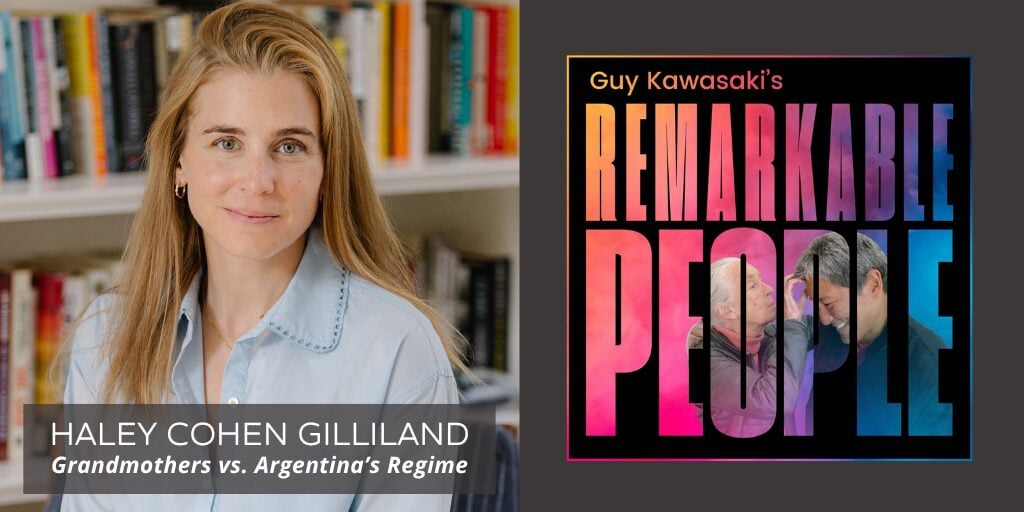
Welcome to Remarkable People. We’re on a mission to make you remarkable. Helping me in this episode is Haley Cohen Gilliland.
Haley is a storyteller who uncovers the human courage buried inside history’s darkest moments. Her reporting blends investigative rigor with narrative depth, and her work explores how individuals confront power, injustice, and moral catastrophe. Today she directs the Yale Journalism Initiative while continuing to write deeply reported nonfiction. Her new book, A Flower Traveled in My Blood, reveals an astonishing true story most of the world has never heard.
In this episode, we dive into the remarkable movement of Argentina’s Grandmothers of the Plaza de Mayo—women who banded together during a brutal military dictatorship to find their stolen grandchildren. The regime had disappeared thousands of people and secretly placed babies born in captivity into other families under false identities. Refusing to accept silence, these grandmothers turned to science, law, and relentless activism to uncover the truth. Their fight eventually helped pioneer genetic genealogy, laying the foundation for modern DNA identification.
Haley explains how this extraordinary story unfolded—from clandestine investigations to the revolutionary work of geneticist Mary-Claire King, who helped develop the science needed to prove biological relationships across generations. The story raises profound questions about identity, justice, and how societies reckon with traumatic pasts. Above all, it demonstrates how ordinary people—armed with persistence and love—can challenge systems of immense power.
Please enjoy this remarkable episode, The Grandmothers Who Defied a Dictatorship to Find Their Grandchildren with Haley Cohen Gilliland.
If you enjoyed this episode of the Remarkable People podcast, please leave a rating, write a review, and subscribe. Thank you!
Transcript of Guy Kawasaki’s Remarkable People podcast: The Grandmothers Who Defied a Dictatorship to Find Their Grandchildren with Haley Cohen Gilliland.
Guy Kawasaki:
Good morning, everybody. It's Guy Kawasaki. Welcome to another episode of the Remarkable People Podcast. We have a very remarkable person with a remarkable story that is in a remarkable book.
It is something I had never heard of, and I've been to Argentina and all this history that proceeded my visit, I had no idea. So, let me give you a quick introduction. Her name is Haley Cohen Gilliland, and she’s a journalist. She's a nonfiction writer. She's director of the Yale Journalism Initiative.
I read her book and Haley, I got to tell you, I wish I could write a book like that, man. That is a magnificent piece of research. So, congratulations. Her work blends, it's like investigative reporting, its literary narrative, it’s centered usually on moral courage and the intersection of personal stories and history and geopolitical events.
Her new book is called A Flower Traveled in My Blood: The Incredible True Story of the Grandmothers Who Fought to Find a Stolen Generation of Children. That’s quite the subtitle, Haley, I mean you really got it covered. So welcome to Remarkable People, Haley.
Haley Cohen Gilliland:
Thank you so much for having me, Guy. I am thrilled to be here and have really enjoyed listening to the show.
Guy Kawasaki:
Oh, I am completely serious. When I read a book like yours, I say, “Guy, how come you can't write a book?” That this is such a magnificent collection of research?” The first question I have for you is the metaphor of the flower in the title. So, a flower can be taken many ways, most of them positive. So why did you pick the flower for the title?
Haley Cohen Gilliland:
So, if you open the book on the first couple of pages, the epigraph. So, the poem at the front of the book is a poem by an Argentine poet named Juan Gelman. And, Gelman wrote this poem actually long before the events that are described in the book, long before the Argentine coup of 1976, but his words really seemed to resonate with the topic that I wanted to explore.
So, the poem starts, it's in Spanish, but the English translation is, “A bird lived in me, a flower traveled in my blood.”
And so much of the story that we're about to talk about revolves around how this group of women who had no traditional markers of power, didn't have money, didn't have political influence, banded together and working as a collective, they were able to leverage the tools of the law and science, in particular, in order to find their grandchildren who had been stolen from them by the military during this coup period.
And so, the flower, to me, it can actually take on several different meanings. But I think the most salient one is a reference to how the grandmothers harnessed the power of genetics in order to find their stolen grandchildren because they recognized that there was something innate in their grandchildren that traveled within them even though they had been stolen and displaced to families that weren't meant to be theirs, and that they could use that inherent, genetic material in order to identify and reunite with them.
Guy Kawasaki:
We will come to a discussion about DNA and markers because I found that very interesting. For one thing, the person who did that, Mary-Claire King, in your book. Her picture is in front of a Macintosh.
So, I said, “Oh, she's got to be a good person right there. She's in front of a Macintosh.” So, give us the gist of this story. Give us the overview so we understand what we're all going to talk about here.
Haley Cohen Gilliland:
Yes. So, my book, A Flower Traveled in My Blood, is about the Abuelas de Plaza de Mayo, who are this incredible group of grandmothers who banded together during Argentina's 1976 to 1983 dictatorship at a time of just absolute carnage in Argentina where the military was disappearing Argentine's left and right and in droves.
The most commonly accepted estimate is that the military ended up disappearing 30,000 people during that time, and among those who were disappeared were 500 women who happened to be pregnant at that time or to have young children and babies at that time.
And so essentially what the military would do because they were trying to purge the country of anyone whose ideas they found “subversive.”
And I put “subversive” in quotes for those who are listening and not watching, they would round people up in unmarked cars, often wearing masks. The resonances are a little bit too eerie for comfort. And take them to these clandestine detention centers where they were tortured for information and then quietly killed.
And this is what happened with the pregnant women as well, with the caveat that the military waited for the women to give birth to their children first, and then stole their children, and in many cases, placed them with military and police families to be raised under false identities. And then quietly killed those mothers who had just given birth.
And so, my book focuses on this phenomenon, but also, it's more focused on the grandmothers who at immense risk to themselves, while all these horrific things were going on, banded together in order to find those stolen babies, their stolen grandchildren.
Guy Kawasaki:
Did the genesis of this book occur when you were working for The Economist when you were in Argentina? You get off the plane, you're working for The Economist, and next thing you know, you're writing about the dirty wards. How does that transition happen?
Haley Cohen Gilliland:
The genesis was sort of diffuse. It's hard to pinpoint the exact moment because I moved to Argentina in 2011 on what was meant to be a one-year research fellowship, and that was the point at which I learned this story. I moved down with a basic working knowledge of what had happened during the dictatorship.
I knew that tens of thousands of Argentines had been disappeared, but I actually hadn't heard of the Abuelas and I didn't know that among those stolen during this time were babies. And so, I was immediately, as most people are, I think, upon learning this story for the first time, just flabbergasted that this had happened, that this had happened so recently, and that I hadn't heard about it.
And so, I immediately became really obsessed with researching the grandmothers, and just spent an inordinate amount of time reading about them, watching documentaries about them, trying to learn as much as I could about them. Then, as you mentioned, I ended up getting a job with The Economist, and two things happened.
One was that I ended up living in Argentina for four years, which was amazing. It was the most fun period of my professional life, but the longer I lived in Argentina, the more I got lulled into this, what ended up being a very false sense that everybody in the world already knew this story because in Argentina, the Abuelas are iconic.
Everybody knows who they are. Most people know this history, although that's changing a little bit with the younger generations. And so, I just got lulled into this sense that everybody already knew this story and I wouldn't be able to necessarily add value by telling it yet again.
And so, that was when the seeds of this project were planted, but it really wasn't until moving back to the state’s years later. And actually, becoming pregnant myself for the first time that their story really came flooding back to me in a very intense and visceral way. And so, I started talking to friends about it, many of whom studied history as I did in college.
And nobody knew that this had happened. And that was what reassured me that there was a real value in bringing this story to an audience that might not otherwise be familiar with it.
Guy Kawasaki:
So how many years did it take to write this book? It's 2026 now. It just came out.
Haley Cohen Gilliland:
Yeah, so I would say I moved to Argentina in 2011. I lived there from 2011 to 2015, and that time definitely informed the research that went into this book, but I officially started working on this book in February of 2021. And so, it took almost five years. It took about four and a half years of research and writing. And it was a very, very intense process, but also an incredibly gratifying one.
Guy Kawasaki:
How did you get the grandmothers to open up to you? You must have conducted a lot of interviews, right?
Haley Cohen Gilliland:
I did. This book is a fusion of a lot of archival research. I can talk about some of the archives that I used and some of the other researchers who I'm so grateful to because they put their research out there for public consumption. Original reporting as much as I could, I spoke to every surviving grandmother and spent as much time with them as I could.
I spoke to many of the grandchildren who had been recovered by the grandmothers, so it's a real fusion of historical research and then current, reporting. I spent a huge amount of time with Dr. Mary-Claire King, who we already mentioned.
She was incredibly generous with her time, and the largest challenge with the grandmothers was that by the time I officially started this project in 2021, many had passed away, and those who continued to work with the Abuelas, I think the youngest woman was in her mid-eighties, which I thought of as she was a total spring chicken because comparatively the main subject of my book, Rosa Roisinblit was 102 when I started this project.
And so that was a real challenge just in terms of spending lots of time with these women who, at this point in their life, were not always feeling their best every day.
But I would say, one thing that was so heartening throughout the entire process was that these interviews were difficult, as you can imagine, because I was asking these women, who were in their nineties, and in Rosa's case, a hundreds, to relive the most traumatic, difficult moments of their life, and I felt quite guilty about that. I'm not always able to put on an unemotional reporter's hat.
And so, I felt quite guilty about it and would sometimes apologize to these women for making them relive these moments and without exception, all of the women said, “No, thank you for telling this story because we want it to be known as widely as possible,” and it's not known as widely as it should be outside of Argentina, and it's possible that there are lots of grandchildren who at this point are outside of Argentina.
Argentina as a country has gone through lots of periods of intense economic and political turmoil. And so there have been these periods of intense migration out of Argentina, especially when it comes to young people and the grandmothers have found at least one grandchild in the United States.
And so, they were very heartened by the prospect of spreading the story even further outside of the bounds of Argentina.
Guy Kawasaki:
So, people listening to this, they may be wondering, why is it the grandparent generation? Why is the grandmothers, and correct me if I'm wrong, but basically, it's because all the parents were killed? You couldn't go talk to the parents, you had to go one generation backwards, right?
Haley Cohen Gilliland:
Exactly, yes. So, in this case, the mothers and fathers of these babies who were stolen were in almost all cases, disappeared. And so, it was the grandmothers who were left with this incredibly challenging and dangerous mission to find them.
And another point that I find interesting, you didn't ask this question, but I'm just going to bring it up, is why it was grandmothers. Where were the grandfathers? The grandmothers’ movement was really dominated by women, and there are a couple of explanations for why that is, some of which I find more compelling than others.
The practical explanation is just that Argentina in the 1970s and eighties was a traditional patriarchal society. And so, for the most part, the men had to continue to work to support their families and to pay bills.
And so that meant that the grandmothers who had largely left their careers in order to raise their families were the ones who were left with just time in order to do this really intensive investigation, but the more compelling reason, I think, is that the grandmothers recognized that as women of a certain age, at the point when their grandchildren were taken, they were mostly in their fifties and sixties.
They were going to be underestimated and overlooked by the military, and they could use that to their great advantage. And over the course of the book, I really try to describe how the grandmothers leaned into this cultural camouflage of sorts.
So, for instance, they would have these surreptitious meetings at cafes at the beginning of their movement before they had a headquarters. And they would bring knitting needles to place next to their coffee cups to just play up the idea that they were harmless little grannies. Or in one case, they had to smuggle sensitive documents back from Brazil.
And the way that they did that was to buy a box of chocolates, eat all the chocolates from the chocolate truffles, and then crumple up their notes and put them in wrappers so that when they went through the airport checkpoint and a military officer was revising the contents of their bags, they just looked like little old grannies who were bringing chocolates home to their grandkids.
And they were quickly waved through. So, they really leaned into the fact that they were underestimated and overlooked as an advantage.
Guy Kawasaki:
Can you tell me like psychologically or philosophically, do they look upon themselves as heroes, as do-gooders or they're just grandparents who are concerned about their grandchildren? What's their mindset here?
Haley Cohen Gilliland:
Yeah, I hesitate to put words in their mouth without being able to pose that exact question to them. But I think from just talking to many of the Abuelas and from reading so many of their interviews that they had done before I was able to talk to them, they would argue that they had no other choice. This was not a decision they made.
It was a compulsion to find out the truth of what had happened to their children, to fight for that truth, to be made public and then to find their stolen grandchildren.
And that's a little bit of another way in which the flower metaphor, I think, comes up for me because the grandmothers talked about just this sense of primal maternal and grand maternal love that compelled them through immense fear and immense danger because it wasn't that they were fearless.
They have talked often about how scared they were. There was a kind of sister movement, the Mothers of the Plaza de Mayo, and very early on in that movement, three of those women were disappeared. One in broad daylight from in front of her apartment or close by, and two from a church.
They were dragged from a church and taken away. And so, the grandmothers were intimately aware of how dangerous their work was, but they felt as though they were powered by a greater force than fear, and that was the primal desire to find and reconnect with their stolen grandchildren.
Guy Kawasaki:
So, based on the research that you did, do you think that heroes like them, and I do consider them heroes, do you think they're born or they're made?
Haley Cohen Gilliland:
That's such a good question. I think they're both. I think that the circumstances in Argentina forced these women, once again, filled them with this primal desire in order to find their grandchildren, allowed these heroic impulses to come to the surface.
But there were plenty of people who didn't have that same impulse and went through the dictatorship restraining themselves from doing any sort of investigation out of fear.
So, I think the grandmothers who did end up working together probably did have something innate that was within each of them and the circumstances unlocked that, but it's such a tough question. It's a very good question.
Guy Kawasaki:
So, what happens to the grandchildren? So, the grandchildren probably thought that the parents were their parents, but they really weren't their parents. And now with testing and stuff, you discover I was stolen and I was given to, whatever.
So now I mean talk about shaking your roots and destroying your world. So, what was the reaction of kids as they found out that their heritage is not quite what they were brought up with?
Haley Cohen Gilliland:
It was extremely difficult. So, the book traces the path of the first restitutions. So, when the grandmothers first recovered their grandchildren starting in 1979, and it goes up until the present day. So, this is a continuous mission. The Abuelas are still doing this work, and they're now supported by many of the grandchildren that they have found in doing this work.
But about 140 grandchildren of an estimated 500 have been found. So, there's a lot more work to do, and this is an ongoing mission, and I just want to say that. I think when the grandmothers began this mission in the mid 1970s, mid to late 1970s. They imagine that finding their grandchildren was going to be the most formidable challenge that they faced.
And very early on they were confronted with the reality that actually what came after that was often quite complicated. So, when they were finding grandchildren who were still minors, who were under eighteen.
Often, they had to be involved in very intense and vitriolic custody battles over reclaiming those grandchildren because many of the grandchildren, though not all, ended up in the hands of military and police officers who were not only aware of what had happened during the dictatorship, but sometimes were complicit.
And these families often fought really hard to hold on to these babies and children that they had stolen. And so, the grandmothers got embroiled in these incredibly fierce custody battles when the grandchildren were still minors.
Then when the grandchildren became legal adults, the challenge became different, and that was that, as you mentioned, many of these grandchildren grew up with a completely false idea of who their family was and what their identity was that was based on a foundation of abject lies.
And, when they were confronted with the truth, it was incredibly hard to process. Imagine being raised by a set of parents with siblings and sometimes their childhoods were not unhappy. Some of these children grew up in fairly idyllic situations and they were treated well by these appropriative of parents and didn't have an unhappy existence.
And then to be told when you're eighteen or nineteen or twenty, actually your parents aren't your parents. Maybe your siblings aren't your siblings and the people that you thought were your parents might have been involved in the murder and disappearance of your actual parents.
That's incredibly hard to wrap one's head around. And so, when the grandchildren became adults, the grandmothers dealt with a lot of having to walk the grandchildren that they found through these incredibly complex psychological dynamics of finding out that their identities were a lie, and so that was really challenging.
Guy Kawasaki:
I have to ask you this question. A journalist encounters something like this, there's this theory about journalistic neutralism, and you got to present both sides, but when you encounter something like this, is that idealistic desire to show both sides, is that just total bullshit? There is no both sides, right? There's only one side in this. So how do you handle this as a journalist?
Haley Cohen Gilliland:
It's a great question and I thought about this a lot. I think for me, both sides is not the same thing as neutral because I think neutral means doing the most rigorous research that you possibly can and then relating for readers where that evidence led you and that often will not be an equal balance between two sides.
And so, the way that I thought about this was I just tried to do the most rigorous investigation that I possibly could. I tried to document where everything came from in the book.
So, one of the parts of the book that I'm actually proudest of, I don't know if you got to them, but is the endnote section, which is almost eighty pages long, and a real bear to organize, but I think for me it just meant trying to get as close to, especially when I was researching historical events that I was not party to personally.
I was not there. I was not born in the 1970s. It just meant doing an inordinate amount of research to try to get as close to what actually happened as possible and then to relate that. So that's what it means in practice for me.
Guy Kawasaki:
Yeah. As a West coast liberal, I live in a bubble obviously, and when I read a story like this, I say, “How can this happen?” But then if you really think about it. In America, there were Native American boarding schools. Australia, there was a whole lost generation. In Canada, there was a whole stolen generation.
We're talking Australia, Canada, and US. So now obviously it's different because the parents weren't disappeared necessarily in all these countries, but surely there's parallels. Can you wrap your mind around the parallels of what people are capable of doing?
Haley Cohen Gilliland:
Yeah, those are a couple of examples. I think in the modern day, we could talk about Ukraine and Russia. And this also historically happened in Germany during World War II, in Chile during the same dictatorship period with, in those cases, the parents weren't always killed or disappeared, as you mentioned.
But it is not a phenomenon that is confined to Argentina by any means. And I think it speaks to the depths that humans can sink to when they dehumanize the other.
So, to put it in the context of the case of Argentina, the military took power with a very broad and sinister plan, which was to essentially purge the country of anyone with these ideas that it deemed subversive and included in that definition was not just left-wing revolutionaries who had risen up in resistance to the military, but also journalists, artists, poets, nuns who ministered to the poor, priests who ministered to the poor, lawyers who represented the disappeared.
And I think the military began to think of those people as subhuman. And when that happens, I think humans are capable of really, truly awful things.
Guy Kawasaki:
I was struck by some parallels, but maybe I'm cherry-picking things. People are abducted by these mysterious military police forces with mass and it's not exactly search warrants and all this kind of stuff. And in the middle of this, there's this big divergence, this big distraction called the World Cup. What country's having a World Cup next year?
Am I grasping at straws or do you have some concerns? Would you tell someone who is Hispanic and here on a work visa who's pregnant, you better get your DNA tested because you just never know. Am I being paranoid?
Haley Cohen Gilliland:
I'm always wary to draw direct parallels between things that happened in history, especially in different places to the current, and I think, to remind you, in Argentina we were talking about a regime that their preferred manner of disappearing people was to sedate them, strip them naked, and then throw them out of planes over rivers and oceans.
And thankfully we're not seeing anything approximating that today, but the parallels are impossible to ignore and incredibly eerie. You mentioned the masked officers in unmarked cars, just the general erosion of due process. I think the alarming rise of political violence, you know, that we've seen.
All of these are very, very frightening echoes of things that happened in Argentina in the 1970s. So yes, I definitely think that it is valid to be extremely concerned. Do I know that we are going exactly where Argentina went back then? No.
In part just because as a journalist, I tend to look at the past and the current and not really try to make predictions about the future, but yeah, I think, the parallels are incredibly salient and scary.
Guy Kawasaki:
So let me put you on the spot again.
Haley Cohen Gilliland:
Okay.
Guy Kawasaki:
Let's pretend that I am the organizer of TEDx Minneapolis, and I hear this podcast, I buy your book. I read your book. I say, “She would be great for TEDx Minneapolis.” So now you are invited to TEDx Minneapolis. You accept this speaking engagement, you have eighteen minutes at TEDx Minneapolis, what would you tell them based on this book and your experience?
Haley Cohen Gilliland:
I think I would come back to the idea that the grandmothers were this group of women that had just no traditional markers of power.
They were powerless by all definitions. But they recognized that by working together and through relentless work because they started this work in 1977, it is 2026, they're still at it, that they could help to topple one of the most brutal dictatorships in world history and that they could outlast the evil ideology that was espoused during that period in order to achieve their mission, which in this case was finding and reuniting with their grandchildren.
So, I think I would just talk about the power of collective action and I think the hopeful note that I would be able to add specifically around Minneapolis, and I'm stealing this actually from a bookseller in Minneapolis who read the book and then spoke to a publication called Lit Hub about the book.
She was speaking about how resonant it felt to read this book about Argentina in Minneapolis in 2026, but that one of the things that was really heartening to her was that people in Minneapolis seemed to be running towards the danger, which was true of the grandmothers in Argentina, but it was not true of the grand majority of the rest of civil society.
The terror was so all-encompassing and engulfed the country to such an extent that there were many people who either willfully or accidentally just ignored what was going on during that time because the consequences of putting themselves in the crosshairs of the military were too great.
So, this book seller in Minneapolis just mentioned that it had been very heartening and encouraging for her to see Minneapolis residents continue to run toward danger while working together and in resisting what's happening.
Guy Kawasaki:
If anybody listening is from Minneapolis, and if you know whoever is the organizer of TEDx Minneapolis, man, there is not a better guest for TEDx Minneapolis 2026 than Haley. My goodness.
Yeah. Let's talk about reconciliation. You quote two very kind of divergent people here. So, one quote is, “Who cannot remember the past are condemned to repeat it,” that’s number one. On the other hand, the other person says, “We should raise a monument to amnesia.” So those are two extremes.
Haley Cohen Gilliland:
I think the full quote is actually, “We should raise a monument to amnesia and forget where we put it.”
Guy Kawasaki:
Exactly, which is even more powerful. Now, those two things are in direct contradiction. What's your thinking here? Is it reconciliation, resolution or is it amnesia? What do you do after something like this?
Haley Cohen Gilliland:
Argentina, I think has grappled and continues to grapple with that question today. So, depending on who has been in leadership in the country, Argentina is really ping ponged between these opposing impulses of fighting for the truth and fighting to surface all of the awful things that happened during the dictatorship.
And then toward amnesty and I guess, amnesty/reconciliation, both sides making peace. And so just after the dictatorship, Argentina elected somebody who was considered quite a human rights warrior. He created a truth commission to investigate the crimes of the dictatorship.
He very quickly tried to prosecute the leaders of the dictatorship and was successful in that for the most part. There's a great movie called Argentina, 1985, which, if your listeners haven't watched, I highly recommend that's about that trial.
But then he was replaced by another leader who ended up pardoning many of the top military leaders who were responsible for these crimes. And honestly, Argentina has really swung between those dual impulses ever since.
Up until today where we see a leader in office, Javier Milei, who is not necessarily pardoning military officers, but there was a big scandal a couple of years ago when several Congress people from his party actually visited some of the dictatorship era criminals in prison, took pictures with them, had very cordial meetings with them and the narrative that his administration has projected is one that is in direct contradiction with the human rights establishments narrative of what happened during that time.
So, it's quite a revisionist history of what happened during the dictatorship. So, these are really live issues in Argentina as they are elsewhere in the world.
And I think, Argentina is a really interesting case study in how difficult it is and how long it takes for a country to, I don't even want to say heal from because that sounds too pollyannish, but to reconcile such trauma when a country has endured that.
Guy Kawasaki:
You have to say that there are similar streams of thought going on in America right now, right? Towards pardoning and sort of, let’s forget the past, let's not traumatize our current generation. And I think it really applies to this case of do we teach the history of slavery in America or not?
And, there's no doubt in my mind, I think we have to, I'm Japanese American. Do I want Manzanar and the internment swept under the rug because it might traumatize today's youth? Not at all. I think they should absolutely know. So, I'm more on the we got to remember the past to not repeat it. I'll get off my soapbox right now.
Haley Cohen Gilliland:
No, I think traumatizing the youth, that's maybe one explanation that is given for why certain historical narratives are projected. But I think often it comes down to just nationalism and an attempt to control a country's image through censorship. And obviously I'm a journalist. I'm anti-censorship. Yeah, I think I agree with you.
Guy Kawasaki:
So, what are you doing right now besides cashing your royalty checks?
Haley Cohen Gilliland:
What am I doing right now? I am the director of the Yale Journalism Initiative, which is a program at Yale University that aims to help students who are interested in journalism be able to launch their professional journalism careers.
So, it's the best job in the world. I essentially, every week, get to talk to really brilliant students about their ambitions and what they're thinking about doing with their lives.
We have a lot of amazing visiting journalists come. So, just this week we're having Nikole Hannah-Jones come, Zach Seward, who's the AI expert at The New York Times. We just had Jodi Kantor. So, it's a great privilege and so much fun to do that job. And then, I'm starting to think about next book subjects and I don't have anything that has clicked yet.
I think I felt so much conviction around wanting to write this book and so much conviction around the importance of writing this book that I want to wait until I have that level of clarity around another subject before diving in.
But if any listeners are hearing this and have ideas for very rich layered, historical narratives that maybe touch on the present, I'm very accessible online and you can reach out and would love to talk to you.
Guy Kawasaki:
Haley, one of the bizarre things is that fifty years from now Haley’s are going to be looking back at this period and they'll be going through archives and they're looking through YouTube videos and speeches and testimony and all that, they're going to try to recreate what the hell happened in America in 2020 to 2030, but you are living in it. You don't have to look through archives.
In a sense, you are in history. For better or for worse, I'm sure we prefer not to be in such a historical period, but yeah. It's a bizarre time. So, either because of your work in journalism, I'm fascinated, like when I read it, that's what you're doing at Yale.
I said, “What do you possibly teach a journalism student today?” Jeff Bezos, who's has more money than God can't take the loss at The Washington Post. Newsrooms are being gutted and mainstream media is being gutted and all these YouTubers. And so, what do you tell a journalism student today?
Haley Cohen Gilliland:
I think in our program we try to walk a really fine line between being encouraging because there have been lots of very tough historical moments, but I would argue that never have journalists been more important and never has rigorous journalism been more important.
So, we want talented people to go into this field, but balancing that encouragement with realism about the state of the industry, which as you mentioned, in the past couple of weeks with the layoffs at The Washington Post, it's been really hard. And I think when I talk to students, I try to validate and express that I share their sadness and anger about what's going on in the industry.
But also reiterate that for the past twenty-five years because that's how long the program has been functioning, we have fought really hard, both myself and then my colleagues, there are some incredible journalism professors at Yale. Susan Dominus from The New York Times Magazine, Steven Brill, who's also the founder of the program, Sarah Stillman and on and on and on. Emily Bazelon.
All these people who are in positions of power within various news organizations are going to continue to fight to help you do this work if this is what you've decided your calling is. So, that's basically the very delicate line that we try to walk when speaking with students.
But it is a really difficult time for the industry and we certainly don't try to whitewash that. We want people to go in clear-eyed. I do think there are certain people who just have the bug for this kind of work, and they're not going to be fulfilled unless they try to make it work.
And if they can't, journalism skills are so transferable to so many other fields and types of work. So, we, yeah, try to strike that balance between being realistic and encouraging.
Guy Kawasaki:
And, is there a sort of an entrepreneurial track where you say, “Yeah, you might not go to work for The New York Times or The Washington Post, but look at Heather Cox Richardson. I would make the case is a brand unto herself, right?
Haley Cohen Gilliland:
Absolutely.
Guy Kawasaki:
It’s not because she writes for The New York Times. She's the Heather Cox Richardson. So, is there an entrepreneurial path for journalism students today?
Haley Cohen Gilliland:
Certainly, I think as traditional paths have shrunken, these unconventional paths have opened up and for an entrepreneurial student with a strong voice with a lot of clarity around what their niche is going to be and what value they're going to add, I think there are certainly opportunities.
I think it's still hard to make it work, to have a successful Substack, especially early on in your career before you've maybe built a foundation somewhere else or built up an audience, but it's certainly a path that's available that wasn't when I was a student fifteen years ago.
Guy Kawasaki:
The other day, do you know who Rick Smolan is? He made the “Day in the Life” series.
Haley Cohen Gilliland:
Okay.
Guy Kawasaki:
Yeah, so he sent me a picture. It was someone holding up a sign that said, I'm paraphrasing, but the sign said they came for the journalists and then we don't know what happened. Isn't that the accurate assessment right now?
Haley Cohen Gilliland:
Yeah, that's heavy. The Washington Post motto, “Democracy Dies in Darkness.” We're getting there certainly. I do have a lot of faith in my colleagues. We're generally in the field to fight, to make sure that the truth surfaces. And I think that relates back to the book as well.
One of the lessons of writing the book, I think, was that the military was so incredibly powerful and so terrifying, and it tried so hard to obscure the truth both philosophically, but also literally.
It was disappearing people and making sure that the evidence of their murders disappeared and vanished, but the grandmothers’ relentlessness and their refusal to step down meant that eventually the truth did surface. So, I think as long as you do have people continuing to fight for the truth that over time, it will come to light. And so maybe that's overly optimistic, but that is my hope.
Guy Kawasaki:
I found the story of the use of DNA, forensic DNA fascinating. The hero here is a woman named Mary-Claire King, and she's at the University of Washington. So, can you explain what she did in her role here? And that'll be the last topic I ask you about.
Haley Cohen Gilliland:
It's a good thing. It's a very rich one. So, you're going to have to cut me off whenever you want me to stop talking, but I could talk about Dr. King all day.
So, just to set the context, in the 1970s, the late 1970s, when they were beginning embarking on this mission, the grandmothers early on recognized that they were going to need to turn to science to provide an objective tool that allowed them to identify and reclaim their grandchildren because in many cases, the grandmothers who were a part of the Abuelas Organization had never met their grandchildren.
These were babies who were taken when they were still in the womb. And so, they did not know if their grandchildren had birthmarks. They did not know for the most part what sex they were. They didn't know if they had blue eyes or brown eyes or green eyes.
They knew nothing about them to be able to identify them physically, and so they knew that they were going to need to work with a scientist to develop some sort of tool, and they spent years searching for a scientist who would work with them to create a grand paternity test, a test that would connect a grandparent to a grandchild without any blood from the intermediary generation, which in this case had been disappeared, but this was totally novel.
No one had ever done this before. And so, for the most part, they were met with shrugs for a couple of years until ultimately, the grandmothers connected with Dr. Mary-Claire King, who already was very renowned in the field for showing how similar genetically humans and chimps were, and that work had landed her on the cover of Science, which is like winning an Oscar in the scientific community.
And. Dr. King immediately connected with this mission. She was a human rights warrior of sorts herself. She had gone to graduate school at Berkeley in the 1960s during the Civil Rights Movement and the anti-Vietnam War movement, so had participated in those movements. And she had also worked in Chile during the 1973 coup there when Pinochet took over.
And so, she had firsthand witnessed the horror of dictatorship and the trauma that it can cause to a country.
And then lastly, her daughter Emily was the same exact age as the grandchildren that the grandmothers were seeking, and so it was really not hard as someone who was politically active and socially active for her to imagine that had she been born in Buenos Aires instead of in Chicago, that perhaps she would've been disappeared and her daughter would've needed to be searched for by the grandmothers.
So, she felt an immediate compulsion to help the grandmothers. And working together, they were able to come up with this really pioneering equation that allowed the grandmothers to prove their biological link with their grandchildren.
And that equation and the way that they used it actually formed the basis of genetic genealogy, which is now the underpinning of sites like ancestry.com and also used really widely by law enforcement agencies to convict criminals. So, it was used in the Golden State Killer conviction in your state.
And that all traces back to Dr. King's work with the grandmothers. And she's remained a close ally of the grandmothers to today and has tried to help them as they continue to update their scientific work.
Guy Kawasaki:
Is she still at the University of Washington? Is she still teaching?
Haley Cohen Gilliland:
I have to remind myself when her birthday is, but at the time when I was doing the bulk of the interviews, she was seventy-eight and this woman has more energy than anyone that I've ever met. I'm in my thirties and I think of myself as pretty energetic and fit, but she just had so much more stamina than I did.
So, the first interview that we did was, I think, four hours long and we worked through lunch. We didn't break for any water. And I was so exhausted by the end of that interview that I knew for the next one I came in, I write about this a bit in the author's note, but I prepped for it like I was going to run a marathon.
I had my hugest Nalgene water bottle. I had an external phone charger and I baked her a banana bread so that if we didn't stop to eat lunch, at least I could, without being rude, take a piece of this banana bread that I'd bake for her. She's incredible. She just is a comet of energy, neutronic stores of energy.
It's amazing. And yes, she's still working and I think she always will work forever.
Guy Kawasaki:
There's a part in the book where you have this quote and I'm going to hack this quote a little bit. All right. So, this is one of my favorite paragraphs in the book, and it says, and I'm now paraphrasing. And bastardizing it.
So, when God was creating America, it begins he endorsed it with the never-ending planes, towering Rocky Mountain peaks full of minerals, sprawling oil fields, and countless other natural resources.
St. Peter asked God if he was being overly generous, pouring so many advantages into just one nation, and God replied, “Don't worry, I'm also giving it to the Americans.” I was going to say Republicans.
Haley Cohen Gilliland:
Yeah, I think the book feels a lot more resonant than I ever could have imagined when I started working on it. Unfortunately, indeed.
Guy Kawasaki:
All right. So, Haley, thank you very much for being on our podcast. I appreciate this very much. Why don’t you take thirty seconds and just pitch your book so everybody listening to this will buy it because they should if they care about history and not repeating history.
Haley Cohen Gilliland:
Sure. Absolutely. Thank you so much for having me. This was a great conversation and my book A Flower Traveled in My Blood is the true story of an incredible group of grandmothers in Argentina who banded together at immense risk to themselves during their country's last dictatorship in order to find their grandchildren who were stolen from them by the military during that time.
As Guy and I have talked about, I think I didn't write this with the intent to highlight parallels between Argentina in the 1970s and the US today, but I think there's a lot to learn from in Argentina's history that could serve us all.
Guy Kawasaki:
Alrighty. Thank you Haley. Thank you for writing this book. It's a very, very powerful and very important book. And let me take a second here to thank my team.
So, the Remarkable People team as Madisun Nuismer, she's the co-producer and the brains behind me. There is Jeff Sieh, co-producer, design whiz. Shannon Hernandez, sound design engineer. Tessa Nuismer, who is our researcher.
So, it's not a big team, but it's a remarkable team and we're just trying to inspire people. So, thank you very much and I look forward to your next book. Alright.
Haley Cohen Gilliland:
Thank you and I look forward to talking again someday soon.
Sign up to receive email updates
Enter your name and email address below and I'll send you periodic updates about the podcast.

Leave a Reply