
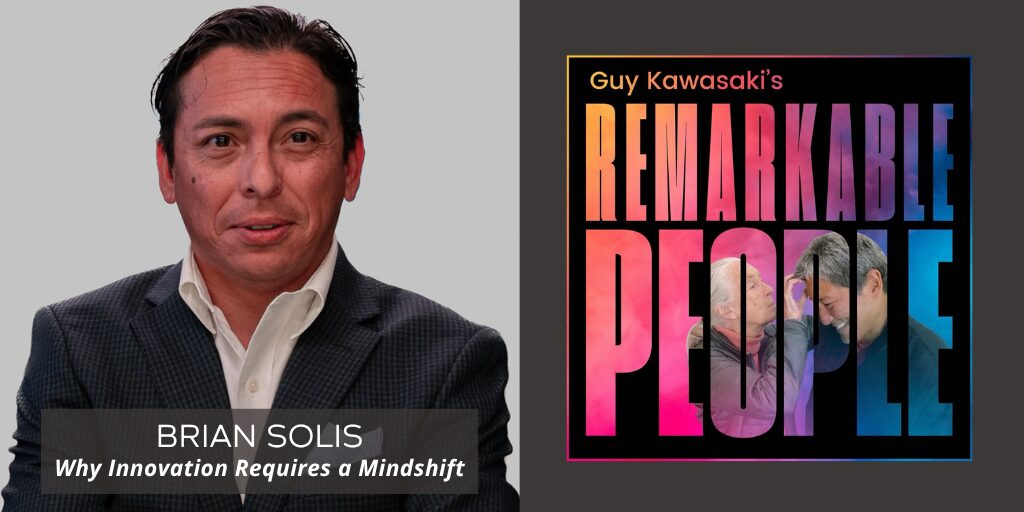
Welcome to Remarkable People. We’re on a mission to make you remarkable. Helping me in this episode is Brian Solis.
Brian is shaping how leaders understand the future of business and technology. As the Head of Global Innovation at ServiceNow and a bestselling author, he has spent decades advising executives on how to anticipate disruption instead of reacting to it.
His latest book, Mindshift, distills those lessons into a framework for seeing what others miss and acting on it early. But more than titles and roles, Brian brings a rare combination of optimism and rigor to the question of what’s next.
In this episode, we explore what it actually means to have a “mindshift” and why most organizations fail to achieve it. Brian breaks down the difference between automation and augmentation—why doing the same things faster isn’t enough, and how real breakthroughs come from asking entirely new questions. He shares how leaders can move from linear thinking to exponential impact, and why self-awareness is the starting point for any meaningful transformation. Along the way, we unpack how even iconic innovators needed help seeing the future clearly.
The conversation also dives into the human side of change—why people resist it, how storytelling unlocks belief, and what it takes to build momentum inside organizations that prefer the status quo. Brian explains how movements are created, not mandated, and why the best leaders don’t position themselves as heroes, but as guides helping others see their role in the outcome. If you’ve ever felt stuck optimizing yesterday instead of building tomorrow, this episode—and Mindshift—will challenge you to think differently about your role in shaping the future.
Please enjoy this remarkable episode, Why Innovation Demands a Mindshift with Brian Solis.
If you enjoyed this episode of the Remarkable People podcast, please leave a rating, write a review, and subscribe. Thank you!
Transcript of Guy Kawasaki’s Remarkable People podcast: Why Innovation Demands a Mindshift with Brian Solis.
Guy Kawasaki:
Hello everybody. It's Guy Kawasaki. This is the Remarkable People Podcast, and I'm having a remarkable bout of hay fever right now, so I might mute myself during this interview, and so I just wanted to give you a warning here. Today, we have a very remarkable guest. His name is Brian Solis and we go way, way back. It's scary how far back we go.
Brian Solis:
Don't say it out loud.
Guy Kawasaki:
Brian is this world renowned digital analyst, anthropologist, futurist, speaker, bestselling author. Yeah. He's kind of like the Deion Sanders of digital. And, right now, he's the Head of Global Innovation at ServiceNow.
I spoke to ServiceNow recently, and I love that company.
So listen, Brian advises businesses. He advises technology leaders, and he is an expert in a topic that we have all come to love, and that's called mindshifts. So Brian Solis, welcome to Remarkable People.
Brian Solis:
Guy, what a privilege. We've done a lot together. We've hung out together, but I don't think I've been on this side of a conversation with you, so thank you.
Guy Kawasaki:
My pleasure. So let's just start off with something easy. So what in the world is a Mindshift?
Brian Solis:
Aside from being a bestselling book.
Guy Kawasaki:
Get that plug in there.
Brian Solis:
It is something that I hear often. My whole team, we hear it often in board rooms and in C-suites. It's this notion of we need a mindset shift. It's something we hear all the time, which is implying that we need to see things differently. We need to ask different questions. We need to explore with more curiosity and imagination.
And so mindset shift, like we do in Silicon Valley, too many words and letters. And so we shrunk it to mindshift, but we kept the vowels.
Guy Kawasaki:
So basically, you're telling me that you are the combination of Carol Dweck and Brian Solis.
Brian Solis:
Well, that is a remarkable person.
Guy Kawasaki:
Yeah.
Brian Solis:
And to be in the same sentence is a dream. Her growth mindset is something that I do analyze and build on in the book, and it's something that I actually practice.
So the idea is then how do you take that and instead of just addressing opportunities in the moment with a growth mindset and a more open mindset, how do you then shift it to start looking at emerging opportunities and signals to start applying that mindset towards the future today, so that we're not reacting to these things, that we're proactively shaping our future.
Guy Kawasaki:
So basically you're saying that a mindshift you could make the case is a mindset because if you have the mindshift mindset, you are looking at the future. You're not just willing to be flexible and learn, you are also looking forward, not just reacting.
Brian Solis:
Yeah, that's a wonderful way to put it, and the idea of a mindset is how do you receive signals? How do you receive information? What is your state? Because oftentimes we're just so busy and caught up with everything from emails to meetings, to headlines, to chaos that we are perpetually just trying to be our best selves in the moment, to do the best we can with what we have.
But if you think about, let's go to COVID in 2020, or the election cycles or ChatGPT in 2022 or whatever's next, these things, there is foresight to some of them. And if there isn't certainty, there's at least scenario planning to be ready for these types of occasions.
And the more that we can prepare ahead, that means the more that we're ready to deal with today differently. And so that's the idea. Yes, it's a mindset. And then the shift is to look more forward to not just anticipate the future but shape it.
Guy Kawasaki:
Using names of companies or people that we would be familiar with, who is in the Brian Solis Hall of Fame for mindshifting?
Brian Solis:
I got to tell you, there are stories that I tell in the book that look forward and don't look forward, but I think one of my favorite stories in the book, and I think you'll appreciate it of anyone, is Apple under Steve Jobs was very much looking towards the future to shape it.
But one of the stories I tell, and it was a real interesting one for me, was that Steve Jobs had to be convinced that the iPhone should be the iPhone.
And that was a story of surprise that even the most forward-looking leaders sometimes need help. And so the book was written for not just the Steve Jobs of the world, but the people who don't know to think that way, and also the people who surround today's leaders.
That we all have an opportunity to influence forward, whether it's upward, downward, sideways, that a mindset shift benefits everyone, including someone like a Steve Jobs.
Guy Kawasaki:
Yeah. So would you say that Elon Musk is a mindshifter? I mean you could say he individually caused the mindshift to electric cars.
Brian Solis:
There's a part in the book where we look at just the whole infrastructure of Tesla. I believe, were we at the same Menlo Park, Tesla Grand opening when the first dealership opened there? It was an old dealership. It became a Tesla dealership.
It was a grand opening, and it was an example of what happens when you don't just launch an electric car, but you launch an entire ecosystem to support it, including the charging stations nationwide. So yes, there was a mindshift to see forward.
Guy Kawasaki:
Well, Brian, when that Tesla dealer opened on El Camino in Menlo Park, I was already over the hill and you were just rising, so that's why you got invited and I didn't.
Brian Solis:
I wouldn't get invited now.
Guy Kawasaki:
I was probably at Stacks eating lunch when this was happening, and I had no idea.
Brian Solis:
I miss Stacks.
Guy Kawasaki:
I found out there's a Stacks in Campbell, there's a Stacks in Menlo Park and there's a Stacks in Redwood City.
Brian Solis:
That's the one I know is the one in Redwood City/Woodside.
Guy Kawasaki:
Yeah. Okay. But now, author to author, I got to say that when I was reading your book, and you praise Elon Musk as a mindshifter and all that. I said, “Oh my God, I'm reading this book in 2025.” And I'd say, “Ah, poor Brian. He put that Nazi in the book. Oh, what's he going to do now?”
And I got to tell you, I feel that pain, any one of us. Hey, Brian disappeared. What happened? Any one of us. We could have used Bill Gates as an example. There’s a lot of people in the Epstein files that are in a lot of business books that are held up as heroes, right? I don't know.
Brian Solis:
One of the things that I'm guilty of is being a hopeless optimist, and for better or worse, I've always tried to see the good in people, and that was one example of it. I genuinely admired someone who walked away with a big payout from PayPal, regardless of the backstories that we all know or heard or saw.
This was someone who took those proceeds and went into SpaceX and went into Tesla and went into the idea of what X could ultimately become in terms of a super app back in the day. And that was noteworthy. That was very much when Silicon Valley was about bold ambition, make it happen, do or die, fail forward.
And you can't predict what's happening behind closed doors when you want to see the best in people.
Guy Kawasaki:
Yeah, you know there's a handful of people right now, they could walk off into the sunset saying, “I changed the world.” I would make the case that Elon Musk has changed the world more than Steve Jobs, because Steve Jobs just did computers and phones and pads, but Elon, he did cars and space and tunnels and neural chips.
And he was all over the map. I could make the case he has caused more mindshifts than Steve Jobs, and he could have sailed into the sunset as the richest man in the world who's the most creative and innovative. But no, that's okay. Let's not get into this. I don't want to get you fired from ServiceNow.
Brian Solis:
Well, he keeps Kara Swisher busy.
Guy Kawasaki:
Where would Kara Swisher and Scott Galloway be?
Brian Solis:
You're right. And look, to be fair, I have a young family at home. If I changed the world like that, I would spend time with them, just to be honest.
Guy Kawasaki:
Yeah. Wait, I want to make that clear. So if you were a trillionaire, you wouldn't be working anymore? You would just be spending time with your family?
Brian Solis:
I probably would've stopped at millionaire and be happy with spending time with the family.
Guy Kawasaki:
I can relate to that, Brian, because I told myself that I was going to stop when my net worth was 999,999,099 dollars because I don't want to get billionaire's disease. Luckily, I'm not even close to that. Canva has been good to me, don't get me wrong, but not that good. So anyway.
Brian Solis:
I do remember you've always been on the cutting edge of what was next and Canva, when you worked with Canva, I thought, Man, this is Guy being Guy, always ahead of the curve. I should have followed in your footsteps on that one.
Guy Kawasaki:
Brian, in a rare moment of transparency and honesty, let me tell you, I've been working with Canva for about eleven years now, and if eleven years ago you had said to me, “Canva is going to be,” I don't know, whatever their recent valuation was, “$40 billion,” I would've said, “I don't think so.” So I would attribute my work with Canva as extremely good fortune.
I listened to a woman named Peg Fitzpatrick, who was helping me with social media. She told me to help Canva. That was my entire due diligence. This is called Guy’s Golden Touch, which is not whatever I touch turns to gold. Guy’s Golden Touch is whatever is gold, Guy touches. I touched Canva and Macintosh and between those two I touched a lot of lead and tin.
Brian Solis:
We all stumble into that good fortune.
Guy Kawasaki:
Listen, we're all from Silicon Valley, right? So when people say, “Guy who have you worked for? What have you done?” I said, “Oh, I was Chief Evangelist of Apple, Chief Evangelist of Canva. Maybe you heard of those two things.”
I don't tell them about the twenty-eight companies between those two things.
Brian Solis:
I know we go back, I won't put dates to it, but I remember when you were launching garage.com.
Guy Kawasaki:
Yeah.
Brian Solis:
And that was a big deal back in the day.
Guy Kawasaki:
We thought it would be a big deal as opposed to being a big deal. Okay, so enough of my checkered past. I don't want you to get political too much, but no matter where you are on the political spectrum, it seems to me it requires a different kind of mindset and mindshift to think about the future. It is a very different world, right? So now what is required to have a mindshift today?
Seeing all these kind of divergent forces, opposing forces. Some would say bad forces. Some would say good forces. What do I tell my kids about five years? What will America be?
Brian Solis:
I have two young daughters at home, and I think about this all the time. And there is a scenario of the future that exists across the spectrum, right? Bad and wonderful. And what separates them is the evidence that shows how likely each one is. What brings one to light is what we're going to do about it.
So the book at the end talks about how do you create a movement in the direction of the future you want to see? And that's the part, to be honest, that's the hardest. I dedicate three or four chapters to it because people want to complain, people want to wish and dream, but to manifest it is where the magic happens.
And that has been my entire career. Not everything has worked out the way that I envisioned, but I can always say that I put the work in to try to bring that future to life. And that's what I hope my children see is that if they want the future the way that they envision it, then they have to do something about it.
Guy Kawasaki:
So give us the gist of those three chapters. How do you make your mindshift come true?
Brian Solis:
Before we get to that chapter, the first part of the book is sharing why you're not in the right place to do that.
Guy Kawasaki:
Okay. Tell us why.
Brian Solis:
So for example, I think we all have some idea of where we are and some idea of where we want to go, but the detachment between that is, is that really where we want to be?
And are we doing the things every day to make that happen? And that's an exploration I ventured through with the last book, which was called Lifescale. Like where do you want to see your life and how are you scaling your way towards that?
The biggest thing I had learned was that when I broke out the day to day, the week to week, the month to month activities where I thought I was going versus where I was spending my time, I was completely focused on the swirl.
All the stuff that keeps the day to day going, oh this distraction, this distraction, this emergency, this urgency, oh this priority. And so self-awareness, which is a big part of the beginning of the book, is a gift that most of us do not have, and we don't even know it.
So there was an interesting study that talked about how a hundred percent of us believe that we're self-aware, but in fact only 10 percent of us are self-aware.
And you could link self-awareness to things like empathy and curiosity and that kind of goes to show you how susceptible we are as a society to be manipulated. Hence, the bigger conversation. And then as we get to later in the book, the gap between self-awareness and then what we're going to talk about in the last three chapters are how do you have a vision?
How do you latch onto that vision to know it's important? How do you know that it's not just important, but it’s beneficial to you and the people or things or companies you care about.
And then the science, as we get to the last three chapters, shows how movements are created, how revolutions are started, and then it really gets down into something I think you'd appreciate.
It's a word that we use or misuse, I should say, quite often, but it gets into the art and science of actual storytelling, going back to Socrates but really landing it home with Pixar and the idea of The Story Spine and how this was a big learning for me. I brought in a guy by the name of Nicholas Sung, who's a former Pixar storyboard artist.
And Silicon Valley might know him because he's the one who helped transform Airbnb with the famous storyboards that they have in their lobby.
And what he had taught me about storyboarding was that the mistake most storytellers make is that they see themselves or the product or the company as the hero of the story, and therefore as they tell the story, it's very much self-centered.
And hence the self-awareness challenge. He said, “The actual hero of the story are the people you're trying to help and the outcome that they don't know they can achieve without you.” And also how they play a part in bringing that future to life.
And this is why Pixar movies, Disney movies are the good ones, are really thoughtful, where you have an emotional journey throughout that arc and the last three chapters break down how you make people, your teams, your boss, your customers, whoever it is, your constituents, if we're talking about politics, how you get them to believe they are part of the solution.
And in the process of getting there, you're taking out things like unknowns and uncertainty and anxiety, and you're making it more tangible and actionable and measurable so that people see themselves in the outcome.
Guy Kawasaki:
Okay. Brian, can a mindshift be a negative thing? Obviously people have done evil things, and somebody had a mindshift that says, “Let's just have a fascist society,” or something like that. What happens if you have a negative mindshift? Or you're saying mindshifts are always positive and the high road and stuff like that?
Brian Solis:
The hopeless optimist in me wants to believe that every mindshift is for the good of change. Change is hard. Change is difficult, but self-awareness becomes a thing where once you taste something so profound, say power, say money, say influence, say all of those things, you're no longer mindshifting.
Your mind is being shifted for you, and people don't push or fight back because the short term accolades, benefits, rewards, bank accounts, whatever it is, airplanes, jets, these things now become symbolic of validation cycle for better or worse. Right? A therapist would say, “You are easing the pain of doing this, at least initially by the rewards you are receiving.”
And over time, it becomes a new norm, and it just becomes part of your life. And if you take anybody, pick a name, they probably said some very bad things about becoming a fascist society back years ago. And now you see what they're saying today. It's not an accident.
Guy Kawasaki:
I swear Brian, the only explanation I can have for how some people that I thought on you are behaving now is that we are living in a simulation. That is the only explanation I can get, and God truly has a sense of humor because you cannot make this shit up. Brian, I swear to God.
Brian Solis:
If you take the “F” out of the book title, I think you have what we're talking about.
Guy Kawasaki:
All right, so now I have a chicken and egg question. Do you believe that external factors and changes forces a mindshift? Or does a mindshift create the change? Which comes first?
Brian Solis:
That's a great question. I've never been asked that, by the way.
Guy Kawasaki:
That’s why I am Guy Kawasaki.
Brian Solis:
That's right. For those who are listening, I was just giving Guy the praise emoji in real life.
Guy Kawasaki:
Wayne's World.
Brian Solis:
I think if we look at ChatGPT, that was a mindshift sort of opportunity for people to react. If you think about the famous MIT study that came out last year about how businesses were and weren't using generative AI to their success, ROI, however you measure success.
It's found that 95 percent of enterprises weren't realizing ROI from their generative AI investments, and so the reason why, if you break it down, I read the whole report, and this is actually something I see in day-to-day meetings, is that because we're trying to take something so profoundly different and apply it to the box of business as usual to use this new technology to do yesterday better, faster, cheaper, more efficiently tomorrow.
Nothing wrong with that. We've been doing that very well for hundreds of years. But to answer your question, the egg and the chicken moment is a mindshift is actually to say, “I didn't see this coming.” I know how I would normally react to it which is, oh, let's increase profitability, scalability, all those things.
Where the mindshift comes in is the framework in the book that says, “What am I not asking? What is the desired outcome that I could not achieve without this before?” And so what you now start to do is you break out a framework of improving the past and unlocking an entirely different tomorrow and making the unknown possible.
So that's the egg reaction. The chicken part is how do you keep doing that perpetually so that the next ChatGPT is already on your horizon.
Guy Kawasaki:
Now a famous author created a very good dichotomy with two different words, and the two different words is when it comes to AI, it's automation versus augmentation which when I read in your book, I decided to immediately rip off.
Brian Solis:
I was going to say, “I know this author.”
Guy Kawasaki:
So basically you're saying like the initial reaction to many people for AI is to automate old stuff, but the real mindshift is to augment. It is to do what couldn't be done before as opposed to do what could be done before, but better.
Brian Solis:
Exactly. In fact, my boss, his name is Dave Wright. He's the Chief Innovation Officer at ServiceNow. We came out with a paper late last year. We called it the “AI Mindset” and what it does is it says you need both. You need automation and augmentation because one unlocks linear growth and the other unlocks exponential growth.
And so we had this diagram where strategic automation with the right questions being asked and answered gives you this sort of linear progress. And then asking entirely different questions and exploring and investing in those opportunities unlocks this delta and the gap between the two lines is positive disruption.
And the idea of positive disruption is you're not waiting for something or someone to disrupt you. You are investing in the things that are disrupting yourself, and that is where true innovation actually is born.
And so we came up with a list and if anybody wants this, you could email me at brian@briansolis.com or on social and I'll send you this report because we include all of the questions you need to ask on the automation linear line and on the augmentation exponential line.
Guy Kawasaki:
So Brian, someday you're going to be watching me speak and you're going to hear me discuss automation versus augmentation, and then you're going to hear me say, “Yeah, it's the difference between linear growth and logarithmic growth.”
And you're going to say, “That fricking Guy, he stole my two great metaphors, that asshole, and now he's put it in his speech.” And again, Brian, this is what's called Guy’s Golden Touch, which is augmentation versus automation and linear versus logarithmic. Those are really good concepts to steal from you.
Brian Solis:
Hey. It would be an honor to have it stolen from you. It wouldn't be the first time. I wrote a book called WTF?: What's the Future? And I won't name names, but you could see all the people who borrowed that afterwards.
Guy Kawasaki:
Okay, so now how do I know if I'm hallucinating or delusional versus I'm mindshifting because it's kind of a fine line there.
Brian Solis:
The idea of mindshifting, if we even go back to Carol and Carol Dweck's growth mindset. There is a framework to follow, and so hopefully it's not a similar effect as if you had been out having a great glass of wine or several glasses of wine and you come back knowing you've had several glasses of wine.
I guess maybe not knowing is the right sign that you've had several, but it's a gift you give yourself. It's a discipline, it's a practice. And so I think the most interesting thing, I don't think I even explored this in the book, but I could tell you from experience that it's like getting into the zone.
Csikszentmihalyi once said, “You're in flow state because you don't know you're in flow state.” You just don't even know it. You see the outcome.
Guy Kawasaki:
Yeah. So wait, so are you referring to the guy in Canada and his name starts with C.
Brian Solis:
I'm talking about Csikszentmihalyi, who is regarded as the creator of it.
Guy Kawasaki:
Yeah. I feel sorry for the person who's going to be transcribing this podcast because she's going to say, “Who the hell are they referring to?”
Brian Solis:
Did we even get it right? My goodness. And I'd feel bad if I didn't, but here's a funny story because I talk about flow state and life scale and when I was reading the audio book, I think that was the one place where I had to take multiple takes.
Guy Kawasaki:
You know how much more famous that guy would be if his name was like Dweck or Cialdini or Aaker or Drucker or Kawasaki or Solis. Yeah. I know it starts with a C and there's a Z in there someplace, and that's all I can tell you. Yeah, right after we annex Canada and becomes the fifty-first state, we can change his name or something.
Brian Solis:
Is that before or after Greenland? I forgot the order of things.
Guy Kawasaki:
Okay, so now real world, what happens if you're living in an organization and they are anti-changing minds and mindshifts? What do you do in that case?
Brian Solis:
Oh, I'll just answer from experience. I have been in many of those companies, and I've advised many of those companies I'm sure you have as well.
Guy Kawasaki:
When I see that, I just run the other way.
Brian Solis:
Look, the hopeless optimist in me has created all of these frameworks because if anything was ever easy and people said, “Yeah, for sure, go do it.” I wouldn't need the frameworks. I would just be doing this stuff rather than inventing how to change people's minds or open people's minds.
I can tell you with certainty that even in the most difficult and trying of situations I have seen that it's possible. I have also made decisions where I weighed possibility versus what's the nice way to say it, versus wellness, mental wellness and mental health, where the prize was not worth the cost of my own mental health.
So I have walked away even knowing that the possibility was there, and I've advised people to also do the same, but the frameworks were born from being in those most difficult situations because change is always possible, and this is why the Pixar, or the storytelling or the Socrates things come out as people can see themselves in the outcome that you believe is important for them. Then you have a shot.
Guy Kawasaki:
Oh, okay. So Brian, I'm going to pay you back right now. I'm going to give you two “P” words that you can use. You can rip me off.
Brian Solis:
I'm going to write this down.
Guy Kawasaki:
Yeah, the way you explain that is possibility versus perpetuation. How's that?
Brian Solis:
That's great.
Guy Kawasaki:
It's almost as good as logarithmic versus linear. I'm not Brian Solis, so that's the best I can do.
Brian Solis:
This is why I come on your show, so I can learn.
Guy Kawasaki:
Alright, okay. So I asked the question, what if you work for a place that you know is perpetuation as opposed to possibility. Now, a different question is, because I have a highly qualified, competent listenership, let's say you are the person who has or now is going to embrace mindshifts, but you have people who work for you who do not embrace or support or even understand mindshifts.
So how do you empower people who work for you to create and embrace mindshifts?
Brian Solis:
There's an assumption here that we weren't in charge of hiring the people that are on our teams because I would look for that open-mindedness and optimism, curiosity, imagination. And by the way, it's not just me, and it's not just a mindshift. These are, they call them soft skills.
I call them critical skills for AI. This is the augmentation side of things, right? And I'll get back to a more direct answer, but I have this personal framework that I use. It's a hashtag, W.W.A.I.D., which is, as I'm thinking about augmentation, I ask, “What would AI do in this moment? Prompt aside is like, how would AI at attack this?
And then what it allows me to do is I go through this exercise of exploring through curiosity, imagination, critical thinking, to have an out of body or out of mind experience of which then to lead to a different type of prompting sequences than I normally would have achieved. And so I would be looking as a manager for those types of skills as I hire.
If I do not have them on my team today, and I need to mindshift, and I'm finding it as either difficulty or a possibility, I would invest in the cultivation of those skills, the assessment of them first, and then the cultivation of them, and then the storytelling aspects so that they can see themselves and the outcome of the story.
Even if there's pre-work before the actual mindshifting sequence can begin.
Guy Kawasaki:
Okay, but then Brian, you got to explain how to cultivate that. You just plant them in the ground and throw manure on them? How do you cultivate this?
Brian Solis:
We got to get to the openness first, right? Because it's one of the reasons I have a challenge with the term change management.
No one really likes to change, at least if you're being told to change and no one wants to be managed against it, and the cultivation part of it has to start before like, “Hey, what are we trying to do and what's preventing us from getting there? Where do you want to go? How do you define success? And where are we not achieving any steps in that direction?”
Like we got to break it down, like the old Lifescale methodology that I was working on, which was I didn't know what I didn't know until someone graciously helped me see what I didn't know, and what now knowing looks like in a way that benefits me so that I'm in control of what happens next.
Not because someone's telling me or not because I don't believe that's better for me. It's because I believe wholeheartedly now that someone helped me see what I couldn't see before, and now I can't unsee it.
Guy Kawasaki:
Okay. So let's say that I am an AI believer. I am trying to help my organization or even my family embrace a mindshift towards AI. Now, do I go for the brass ring and paint them a picture of augmentation or do I show them intermediate steps like automation? Let's take the medical field.
So I would make the case that when pathologists start submitting x-rays to an LLM to get help with diagnosis, that is automation, right? That's not augmentation. So augmentation would be a step beyond that. But do you believe that by automating, you can build up the cred to get to augmenting, or you should just go straight to augmenting?
Brian Solis:
A dear friend of ours, Jason Corman, who's the CEO of Gapingvoid Culture Design studio out of Florida. They would say, “It comes down to the culture and the leadership of the organization.” So in some companies we would find that we are operating with a more open-minded leadership already, and they might be open to the exploration or the split investment of iteration.
So the practice of what could be automation and then innovation which would be the net new value creation that could lead to augmentation. And so depending on the culture, the organization's going to depend, one, do you have both of those capacities that can run in parallel and two, what's the balance of how you would shift that?
That's one side. The other side is you have an organization that is just straight up iteration, straight up automation. And they don't even have the culture to ask questions without fear or is my job on the line if I challenge leadership? And this is what Amy Edmondson would say comes down to psychological safety.
So this would be pre-work that we would do in that situation before we even got to that conversation, but let's just say for the sake of having a limited amount of time here, and this goes into the storytelling part of it, sometimes the story has to be part of, I don't know what this means. I don't know what augmentation looks like. I don't know how to be innovative.
My whole experience has taught me how to do yesterday better, and I've been successful at it, but tell me more. What am I not seeing? What am I not hearing? And I think you could appreciate this better than anyone is that everything I learned about how to have those conversations have come from venture capitalists.
What's the upside? What's my ten-x? What's my a hundred-x? What's my a thousand-x? What am I not thinking about? Tell me how in practicing toward uncertainty, I can actually make it more tangible, so that augmentation now starts to look and feel more like an investment portfolio than it does wasting resources.
But the thing that automation does really good, and I'll be super-fast in this one, is that it frees up resources to move to the other side, and that's part of the story.
Guy Kawasaki:
That's part of the game, right? You got to show incremental quick returns. Unfortunately, I believe that's true. And I got to ask you Brian, though, what venture capitalists do you know that have that attitude? Because I don't know any venture capitalists that thinks like that at all.
Brian Solis:
They don't talk like that. But part of my job and part of my whole career has been translating the ideas of others into language that I can action.
Guy Kawasaki:
Every venture capitalist I know is like the people in “Silicon Valley,” the HBO special, so just FYI.
Brian Solis:
I do miss that. I do miss that show, by the way, but I'll give you an example. Vinod Khosla posted, “Businesses don't know what it's about to hit them as the rules of engagement in ten years are going to change completely,” or something like that. And then he followed it up saying, “Only two hundred people in the world know what's happening.”
And I thought, Okay, maybe there's room for 201. And I spent the next series of days and weeks trying to answer what he was saying. And I looked at his investments because clearly he was seeing something in boardrooms and in pitch decks, and I started to reverse engineer it.
So anything's possible to learn from, to start seeing things differently, but I would have to believe that I had something to learn in that moment, which I did.
Guy Kawasaki:
Okay. So which investment of Vinod Khosla do you think is a mindshift?
Brian Solis:
I'm not going to answer this one, I will tell you that there was a really fascinating conversation between him and Aaron Levie in San Francisco last year that I went to, and he essentially had opened up and I actually, you know what, I have the notes from this meeting. And so hold me to this.
I'm actually going to publish the answer to your question. I'm also going to publish the questions he was asking. He was talking about examples from farming to tech to finance of what augmentation looks like on the other side.
So his investments are enabling that, I would say. And Aaron Levie has been quite, prolific, I should say, in what the future of business transformation can look like, on the other side of asking these types of questions.
And so what I had learned from that moment, is that the way he's thinking about his portfolio.
Guy Kawasaki:
Okay, so I'll let you off specifically about Khosla Ventures, but if I were listening to this podcast, I would say, “Okay, Guy, I get it. I understand how sticking an X-ray into a LLM helps me decide if you know that tooth has to come out or that person has blockage in his valves or something. But give us examples of, in AI, what would be augmentation as opposed to automation?”
Brian Solis:
Okay, so the definition, and then we'll get to an example. The definition is augmentation is using, say, something like AI as here's a visual for you. If you watch the movie Alien, Bishop is an android, got all of these capabilities that are superhuman already, but Bishop wears an exoskeleton in order to exponentially lift things that were impossible without that exoskeleton.
Guy Kawasaki:
Yeah.
Brian Solis:
And so I think of, and this is Marshall Kirkpatrick's term actually, and I know you know Marshall. AI is a cognitive exoskeleton, and so the way I think about how I approach the answer is framed in whatever I'm faced with as an investment or as in strategy today.
We can look at automation and then we could say, “What's the cognitive exoskeleton opportunity here? What could we not do before now with this tool that we couldn't do yesterday?”
Look, end to end workflows. This is my business. So when we look at how a workflow is started and ended in an enterprise organization. If you have a system of record, it's usually relegated to that corner of the business.
But when you have a platform, you can now start a workflow that spans multiple systems of record so that you can now have a business outcome and you're now starting to reimagine the shape and inner workings of an enterprise when you can bring silos, datas, and workflows together. That is an example of augmentation.
You are now stitching together things that weren't possible before because now you have tools that, because you started asking these different questions, allow you to transform a business, or as Bill would say, “Reinvent a business.”
I would start with the story though of research that had been done by McKinsey's QuantumBlack that showed that of the twenty-five attributes attached to AI investments in the enterprise.
The number one catalyst for ROI was reimagining workflows end to end in an enterprise. What does that mean? Why is that the number one catalyst? What kind of yield should I be thinking about? You're showing X amount of percent. If we reimagined work for tomorrow in a way that we're not doing it today because we were just focused on making yesterday better.
Talk to me more about that. That now starts to unlock the augmentation conversation.
Guy Kawasaki:
Okay. I'll let you off the hook. I like that. I think I should let you off the hook completely now. I'm just trying to suck everything out of your brain that I can.
Brian Solis:
Like I said, if you're buying drinks, we'll go all night. We can go to Stacks if you want.
Guy Kawasaki:
Oh, yeah. Oh, I love the wheat germ pancakes. Oh, I love those pancakes. Yeah.
Brian Solis:
I'm going to be in Silicon Valley in two weeks. I am. I'm going to Stacks.
Guy Kawasaki:
Oh, okay. Let me know. Maybe I'll meet you. That is worth driving over the hill for me, yeah.
Brian Solis:
I will. And if we don't do it there, we'll do it somewhere else because I'll be in Santa Clara, which is a little closer to you.
Guy Kawasaki:
Alright, so those of you listening, I hope you enjoyed this. We learned how to shift your mind and if nothing else, I want you and I wrote them down. I want you in your presentations to now use three terms, which is linear versus logarithmic. And you could say, “The raises that you have been offering me have been linear, and I think we should go logarithmic in my raises.”
That's the context. You use that. And then there's this automation, which is well and fine and good, but there's really augmentation, which is the next level. And then there's the Guy term of, we're thinking only in possibilities, but that's sure as hell better than sticking in perpetuation.
So it's possibilities versus perpetuation. And the last term that I'm ripping off from Brian is cognitive exoskeleton.
Brian Solis:
That's Marshalls. I borrowed it from him, but hey, look, it sounds like you got your next keynote in play.
Guy Kawasaki:
Oh, no. My keynotes are all top tens. That's only four. I need six more, Brian, get on it. Okay.
Brian Solis:
I’ll remember that.
Guy Kawasaki:
Alrighty, thank you everybody for listening. You know the book, the concept, the perspective, the psychology, the whole logarithmic growth is called a Mindshift. That's the name of the book. The name of the company that Brian works for is ServiceNow.
And I want to thank you for listening. I want to thank you, Brian, for being on our show. I want to thank Madisun Nuismer for being co-producer with Jeff Sieh. I want to thank Shannon Hernandez for sound design. I want to thank Tessa Nuismer for researcher. When I listen to NPR do the kind of credit at a podcast, Brian, NPR does it much better than I do.
I got to copy NPR. But anyway, so this has been Remarkable People. Another remarkable session. Thank you, Brian. You are remarkable. You're just a baller. You're a remarkable baller, Brian Solis.
Brian Solis:
To be in your company Guy is just it’s honestly a privilege. It always has been, and so I'm thankful for our friendship.
Guy Kawasaki:
Must be a boring day in San Clemente, but, okay. All righty. Thank you.
Brian Solis:
Thank you.
Sign up to receive email updates
Enter your name and email address below and I'll send you periodic updates about the podcast.

Leave a Reply